
Vendor Onboarding and the Contract Bottleneck: Why Procurement Teams Lose Weeks Before Work Even Starts
Vendor onboarding stalls at the NDA-to-PO documentation chain. Manual drafting, serial approvals, and fragmented signing add weeks before work starts. Governed templates, parallel approvals, and integrated e-signing fix this.

The Work Cannot Start Until the Paperwork Is Done
Every vendor relationship begins the same way. A business need is identified. A vendor is selected. And then, before any actual work can begin, a documentation chain needs to be completed that was designed for a world where contracts moved by post.
NDA. MSA. SOW. PO. Each document has its own drafting requirements, its own review cycle, its own approval chain, and its own signing sequence. In a well-run procurement function with governed templates and digital workflows, this chain can move in days. In a typical manual environment, it moves in weeks. Sometimes longer.
The cost is direct and specific.
A software implementation delayed three weeks because the MSA sat in a legal inbox. A marketing campaign that missed its window because the agency SOW took two rounds of redlining to agree. A critical infrastructure vendor whose onboarding took longer than the work itself.
These delays are not caused by complex negotiations or unusual terms. They are caused by process friction that is entirely avoidable.
The Vendor Onboarding Documentation Chain
Understanding where the bottleneck lives requires mapping the documentation chain that every new vendor relationship must pass through.
1. The NDA
- Most procurement processes require an NDA before any meaningful commercial discussion can happen.
- In manual environments, NDA turnaround is slower than it should be for a document that is largely standard.
- For high-volume procurement functions onboarding dozens of new vendors per month, NDA delays create a queue that backs up everything downstream.
2. The MSA
- The Master Service Agreement is the commercial and legal backbone of the vendor relationship. It covers payment terms, liability caps, intellectual property, data handling, termination rights, and dispute resolution.
- MSA negotiation is where procurement teams most frequently encounter documentation problems.
- A single round-trip on an MSA takes days in a manual environment. Complex negotiations involve three or four rounds.
3. The SOW
- The Statement of Work defines what the vendor will actually deliver: scope, timelines, milestones, deliverable standards, and pricing.
- SOWs are inherently variable as every engagement is different. But the structure and clause requirements are largely consistent.
- In manual environments, SOWs are drafted from scratch or from informally maintained templates, producing documents that are inconsistent and frequently missing standard provisions.
- A poorly drafted SOW is the source of more vendor disputes than any other document in the onboarding chain. The terms that are vague at onboarding are the ones argued over at delivery.
4. The PO
- The Purchase Order is the final step that releases the commercial relationship. It should be fast.
- In practice, it is frequently delayed by PO approval workflows that are disconnected from the contract approval that preceded it, requiring approvals to be sought again from stakeholders who already signed off on the MSA and SOW.
What a Structured Vendor Onboarding Workflow Looks Like
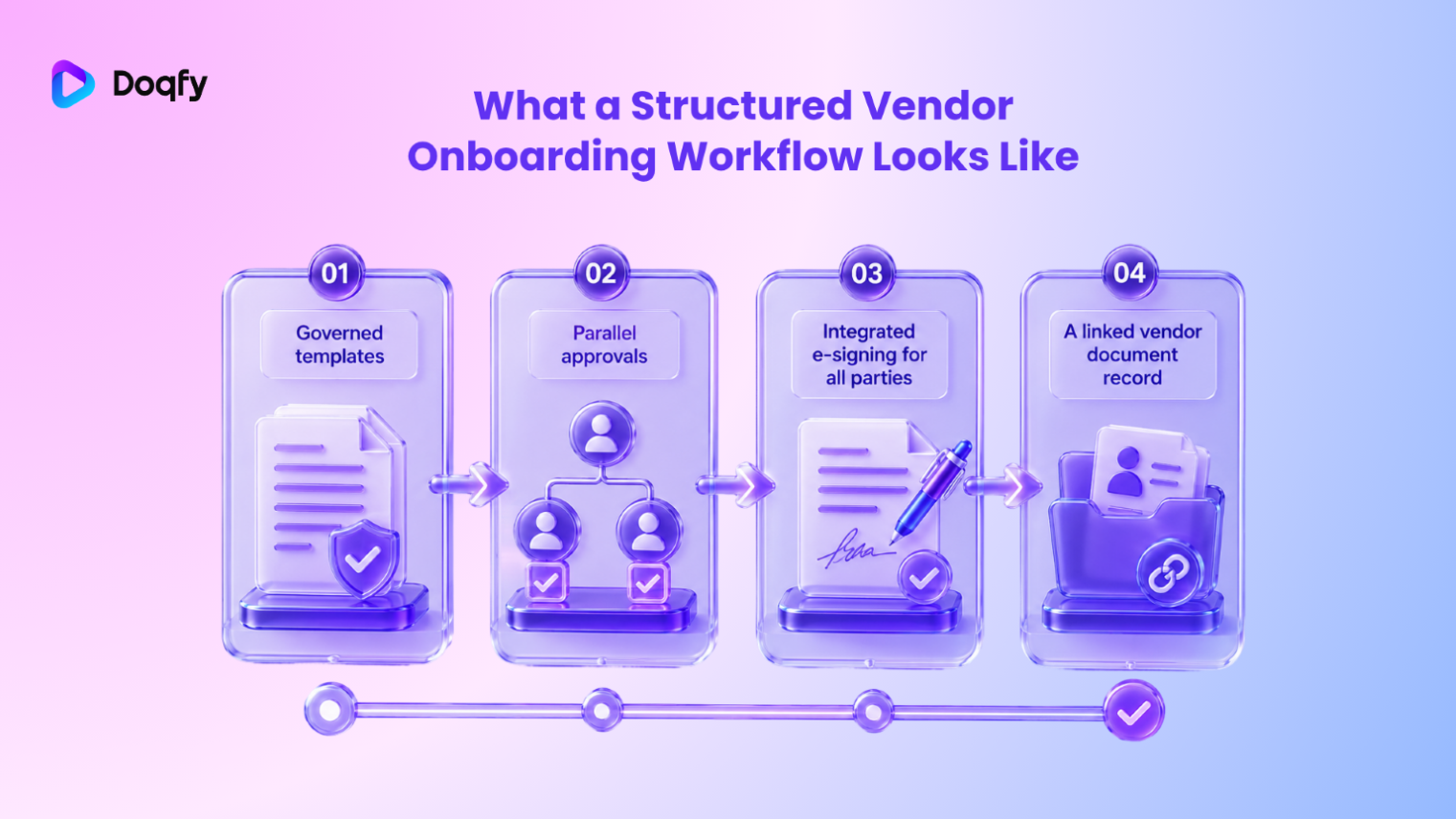
1. Governed templates
- NDA, MSA, SOW, and PO templates should be centrally maintained, with core clauses locked and variable fields clearly defined.
- Standard-risk vendors should be able to move through the NDA stage on a self-serve basis. The vendor receives the standard template, signs, and the executed document is automatically stored. No legal review required for low-risk counterparties.
- MSA templates should include pre-approved fallback positions for the clauses that are most commonly negotiated i.e., liability caps, payment terms, IP ownership, so that deviations from the standard can be approved without legal review each time.
2. Parallel approvals
- Legal, finance, and business approvals do not need to happen sequentially. A CLM workflow that routes the MSA to all three approvers simultaneously, with a defined escalation path if any one review stalls, eliminates the compounding delay of serial approval chains.
- Approval workflows should be calibrated to contract value and risk level. A low-value SOW with a pre-approved vendor on standard terms should not require the same approval chain as a material new commercial relationship.
3. Integrated e-signing for all parties
- Signing coordination is one of the most time-consuming manual steps in vendor onboarding.
- Integrated e-signing eliminates this entirely. Signing workflows are initiated simultaneously for all parties, completion is tracked in real time, and the executed document is automatically stored with a complete audit trail.
4. A linked vendor document record
- The NDA, MSA, SOW, and PO for a given vendor relationship should be stored as a linked set, not as separate files.
- A centralized vendor record that shows all active agreements, their status, their expiry dates, and their amendment history gives procurement teams the visibility they need to manage vendor relationships proactively rather than reactively.
Conclusion
Vendor onboarding delays are not a negotiation problem or a relationship problem. They are a documentation infrastructure problem, and they are almost entirely preventable.
The NDA-to-PO chain that every new vendor relationship must pass through can move in days rather than weeks when templates are governed, approvals run in parallel, signing is integrated, and the resulting documents are stored as a linked, searchable record.
The practical question for procurement teams is not whether to fix this. It is which part of the chain to fix first, and the answer is almost always the one where the most deals are currently stalling.
Streamline your vendor onboarding documentation with Doqfy. Book a demo.