
Governing Third-Party Risk Management Through Structured Contract Controls
How third-party risk can be governed through contract controls: standardized templates, clause playbooks, rule-based approvals, evidence capture, and obligation tracking across vendor onboarding, SLAs, data protection, liability, and termination—with audit history for compliance.
Third-party risk management often starts with an assessment and ends with a dashboard.
The gap is enforceability.
In day-to-day operations, risk is governed through what the vendor can do, what they must do, and what happens if they do not. Those expectations live in the contract.
When contract controls are standardized, routed correctly for approvals, and tracked after signing, third-party risk management becomes measurable.
It also becomes easier to defend during audits, renewals, and incident response.
Why Third-Party Risk Management Leaks Without Structured Contract Controls
Most vendor programs fail for predictable reasons: inconsistent templates, uncontrolled deviations, and weak post-sign follow-through.
These issues might not look like “risk” on day one, but they compound over time.
Below are the most common failure modes that structured contract controls address:
Inconsistent Risk Coverage Across Vendors
Similar vendors end up with very different clauses because each deal is negotiated from scratch.
Deviations From Approved Positions
Liability caps, data security obligations, and termination rights are altered without formal review.
Scattered Evidence
Due diligence documents, insurance certificates, and compliance attestations live in email or shared drives with limited traceability.
Post-Signing Obligations Not Tracked
SLAs, reporting requirements, audit rights, and renewal notice periods are missed because ownership is unclear.
The Contract Controls That Make Third-Party Risk Management Practical
Structured contract controls work when they are explicit, repeatable, and linked to approvals and outcomes.
The objective is not to slow contracting down. The objective is to make risk decisions intentional and visible.
These controls are the core building blocks most organizations standardize:
Templates Aligned to Vendor Category
Separate templates for critical vendors, operational vendors, and low-risk vendors reduce unnecessary negotiation.
Clause Playbooks with Defined Fallback Positions
Negotiation becomes faster when teams know what is acceptable and what requires escalation.
Approval Gates for Risk-Bearing Deviations
Routing based on contract value, vendor criticality, data access, and clause changes prevents informal sign-offs.
Mandatory Evidence Capture
Store due diligence artifacts and renewal documents against the contract record, not as detached files.
Post-Sign Obligation Tracking
Track what matters operationally: reporting cadence, SLA metrics, audit windows, breach notification timelines, and renewal/termination triggers.
Third-Party Risk Management Clauses to Standardize First
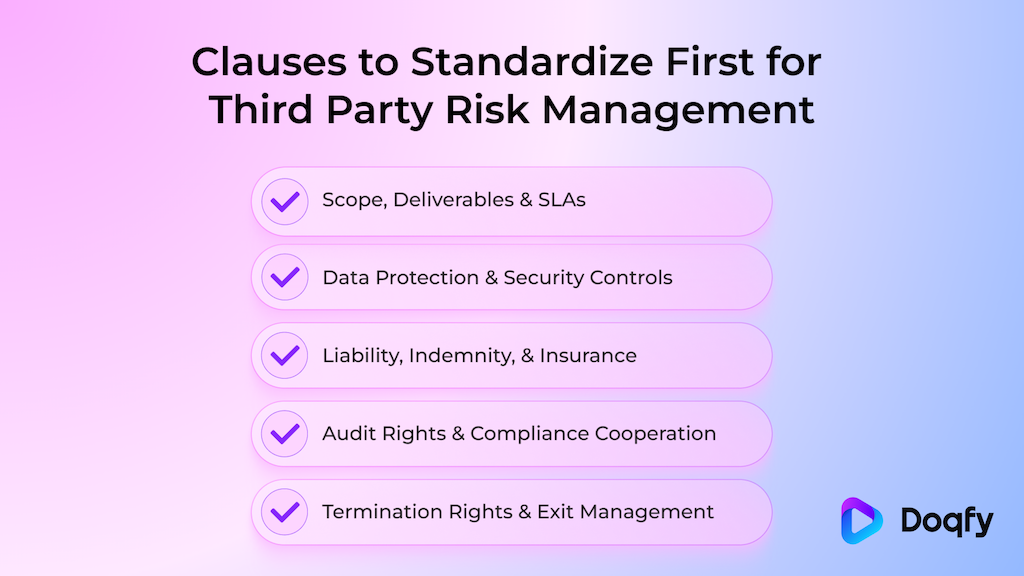
If you are prioritizing, start with clauses that directly shape exposure during incidents and disputes. These terms influence financial outcomes, response speed, and remediation rights.
The clause areas below are typically the first to standardize:
Scope, Deliverables, and Service Levels
Clear acceptance criteria, SLA definitions, service credits, and reporting frequency reduce ambiguity during disputes.
Data Protection and Security Controls
Define data handling obligations, minimum security requirements, subcontractor restrictions, and notification timelines.
Liability, Indemnity, and Insurance
Align caps, carve-outs, indemnity coverage, and insurance requirements to the vendor’s risk profile.
Audit Rights and Compliance Cooperation
Ensure the contract supports audits, evidence requests, and compliance attestations without friction.
Termination Rights and Exit Management
Clarify termination triggers, transition support, data return and deletion, and continuity requirements.
Third-Party Risk Management Needs a “Critical Vendor” Rider
Many organizations handle critical vendors through a standard agreement plus a tighter rider that covers operational resilience and oversight.
This approach keeps contracting efficient while raising controls where it matters most.
A practical critical-vendor rider typically includes:
- Stronger incident response obligations
- Defined business continuity and disaster recovery expectations
- Subcontractor visibility and approval requirements
- Expanded audit and reporting commitments
Implementing Third-Party Risk Management Contract Controls Without Slowing Vendor Onboarding
A common concern is that governance adds cycle time. In practice, delays usually come from unclear standards and repeated rework.
A structured rollout reduces negotiation loops and speeds up approvals because the “default path” becomes predictable.
Here is a rollout sequence that balances speed and control:
Define Vendor Tiers and Map Them to Templates
Establish 3 to 4 tiers based on criticality, data access, regulatory exposure, and spend.
Publish a Clause Playbook that Business Teams Can Use
Document standard language and fallback positions so negotiations do not restart from zero each time.
Automate Approval Routing Based on Measurable Triggers
Route deviations based on clause changes and vendor tier, not subjective judgment.
Create a Contract-Linked Evidence Checklist
Require evidence uploads for insurance, compliance attestations, and due diligence outcomes before execution.
Operationalize Post-Sign Tracking
Assign owners for SLAs, renewals, audit responses, and recurring reporting, with reminders and escalation.
Measuring Third-Party Risk Management Outcomes through Contract Controls
Measurement matters because it shows whether governance is working and where contracts are still creating exposure.
The best metrics are specific enough to change behavior, and simple enough to review monthly.
Use these measures to evaluate effectiveness:
- Deviation rate on high-risk clauses
- Time to approve deviations by vendor tier
- Percentage of contracts with complete evidence packages
- SLA compliance and recurring reporting completion
- Renewal and termination notice adherence
- Time to retrieve documents and audit trails during reviews
Conclusion
Summing up, third-party risk management becomes significantly easier to govern when contracts carry consistent controls, deviations are routed through accountable approvals, and obligations are tracked after signing.
This approach reduces variability across vendors, improves audit readiness, and supports faster action during incidents because rights, responsibilities, and timelines are already documented and retrievable.
If you want to see how structured contract controls can strengthen third-party risk management in your vendor workflows, book a demo with Doqfy today.