
The Hidden Cost of Sorting Out the Contract Later
Informal or delayed contracts create disputes that are hard to resolve because the evidence trail is weak. For tenants, freelancers, and small businesses in India, digital agreements with governed templates and e-signing provide protection that verbal or WhatsApp-based arrangements cannot.

Informal Agreements Feel Fine Until They Are Not
Most people who skip or delay a contract do not think they are taking a risk. They are in a hurry, the relationship feels solid, or the paperwork seems disproportionate to the size of the deal. The plan is always to sort it out later.
Later usually arrives in one of two ways. Either nothing goes wrong and the informality never becomes a problem. Or something does go wrong and the absence of a clear, verifiable agreement makes everything harder, slower, and more expensive than it needed to be.
The second outcome is more common than most people expect, and it affects individuals and small businesses far more than large organisations, which have legal teams to catch what informality misses.
Where Informal Agreements Break Down in Practice
The failure modes are consistent across contexts. The specific document is different; the underlying problem is always the same.
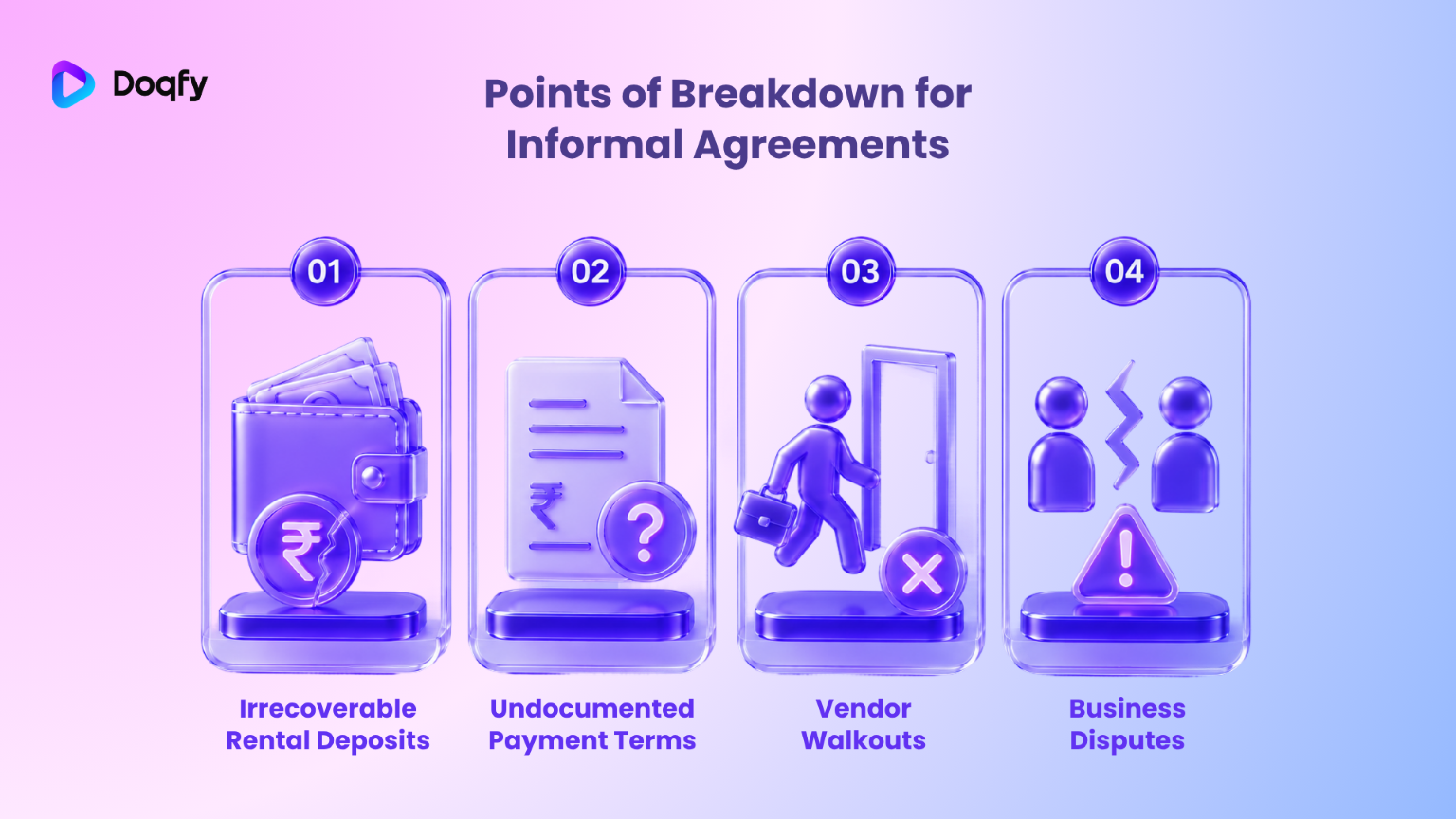
Irrecoverable Rental Deposits
- Tenant moves out. Landlord deducts from the security deposit for repairs.
- The original agreement did not document the property condition at handover, did not define the standard for deductions, and did not specify a timeline for return.
- Both parties have a different recollection of what was agreed. Neither has written proof.
- The tenant can approach a consumer forum, but without a properly documented agreement, the outcome is uncertain and the process is slow.
Undocumented Payment Terms
- Work is completed. The client disputes the scope, delays payment, or disappears.
- The engagement was agreed over WhatsApp or email. No SOW, no payment milestone, no consequence for non-payment was ever formalised.
- The freelancer has done the work and has no enforceable instrument to rely on.
- Under the Indian Contract Act, 1872, a contract requires offer, acceptance, consideration, and free consent. The agreement may technically exist. Proving its terms in a forum or court without documentation is a different matter.
Mid-project Vendor Walkouts
- A vendor is engaged for a service. Work starts without a signed agreement because both sides are eager to move quickly.
- The vendor underdelivers, disputes the scope, or exits the engagement.
- The business has emails and messages but no document that clearly defines deliverables, milestones, or remedies for non-performance.
- Pursuing a claim without clear contractual terms means arguing about what was meant, not what was agreed.
Business Disputes Without Written Terms
- Two people start a business together on the basis of a verbal understanding.
- Revenue, roles, and responsibilities are never formally documented.
- When the relationship deteriorates, each party has a different version of what was agreed on profit sharing, ownership, and exit rights.
- Without a written agreement, the dispute becomes a credibility contest with no clear resolution path.
What A Proper Agreement Actually Protects
A well-drafted, properly executed agreement does several things that informal arrangements cannot.
It records exactly what was agreed
- Payment amount, payment timeline, scope of work, deposit terms, notice periods, and consequences for breach are explicit and unambiguous.
- There is no room for "I thought we agreed" on crucial terms.
It creates verifiable proof of execution
- A digitally executed agreement records who signed, when they signed, and what version of the document they signed.
- This audit trail is available for retrieval at any point and is significantly stronger evidence than a message thread.
It gives both parties a copy they can trust
- In informal arrangements, one party often ends up holding the only copy, or no copy exists at all.
- A digital agreement delivers a verified, identical copy to all parties at execution and keeps it retrievable from a centralized record.
It makes disputes easier to resolve
- When the terms are clear and the execution is documented, most disputes resolve faster because the facts are not in question.
- The party in the right has evidence. The party in the wrong has less room to argue.
Conclusion
Sorting out the contract later is a plan that works right up until the moment it does not. The cost of a dispute without documentation is not just financial. It is the time spent in consumer forums, the stress of a contested relationship, and the difficulty of proving what was clearly understood by both parties at the time.
The practical alternative is not more complexity. It is a governed template, two electronic signatures, and a retrievable record. For most common agreement types, that is achievable in under fifteen minutes.
If the relationship is worth the time it takes to build, it is worth the fifteen minutes it takes to protect.
Manage your agreements end to end with Doqfy. Book a demo today.