
Insurance & Claims Management: Reducing Fraud with Tamper-Proof E-Contracts (2026 Guide)
Tamper-proof e-contracts reduce insurance and claims fraud with end-to-end evidence trails. In India, e-signatures are valid under the IT Act, 2000, and IRDAI e-insurance rules. With IRDAI’s Fraud Monitoring Framework 2025 (effective 1 April 2026), insurers need stronger auditable controls.
Tamper-Proof e-Contracts are Becoming a Fraud-Control Priority in Insurance & Claims Management
Tamper-proof e-contracts are fast-becoming practical fraud control in insurance and claims management, and for good reason.
When claims volumes rise, the easiest fraud attempts often target the easiest weakness: documents that can be edited, swapped, backdated, or re-uploaded without a clear chain of custody.
India already recognizes electronic records and electronic signatures under the Information Technology Act, 2000. The real differentiator now is whether your digital contracts are defensible when a claim is disputed, investigated, or audited.
The Fraud Problem Tamper-Proof e-Contracts Address in Insurance & Claims Management
Fraud rarely announces itself with a villain soundtrack.
It tends to look like “minor paperwork issues”, until it doesn’t. Tamper-proofing focuses on the document integrity gaps that enable repeated patterns.
Here are the most common document-led fraud scenarios that tamper-proof e-contracts can reduce:
- Post-sign edits to key terms
Changing sum insured, add-ons, exclusions, nominee details, or endorsement language after execution
- Version swapping during claims
Uploading an older or altered policy schedule, proposal form, discharge voucher, or consent document
- Backdating and timeline manipulation
Misrepresenting when documents were created, accepted, or signed to fit a claim narrative
- Identity and consent disputes
“I never signed this” or “I didn’t agree to that clause” becoming hard to prove either way.
The 2026 Compliance Context: Tamper-Proof e-Contracts Align with Where Insurance Regulation is Headed
The policy and claims paperwork stack is getting more digital, which increases speed and reach, but also raises expectations on controls.
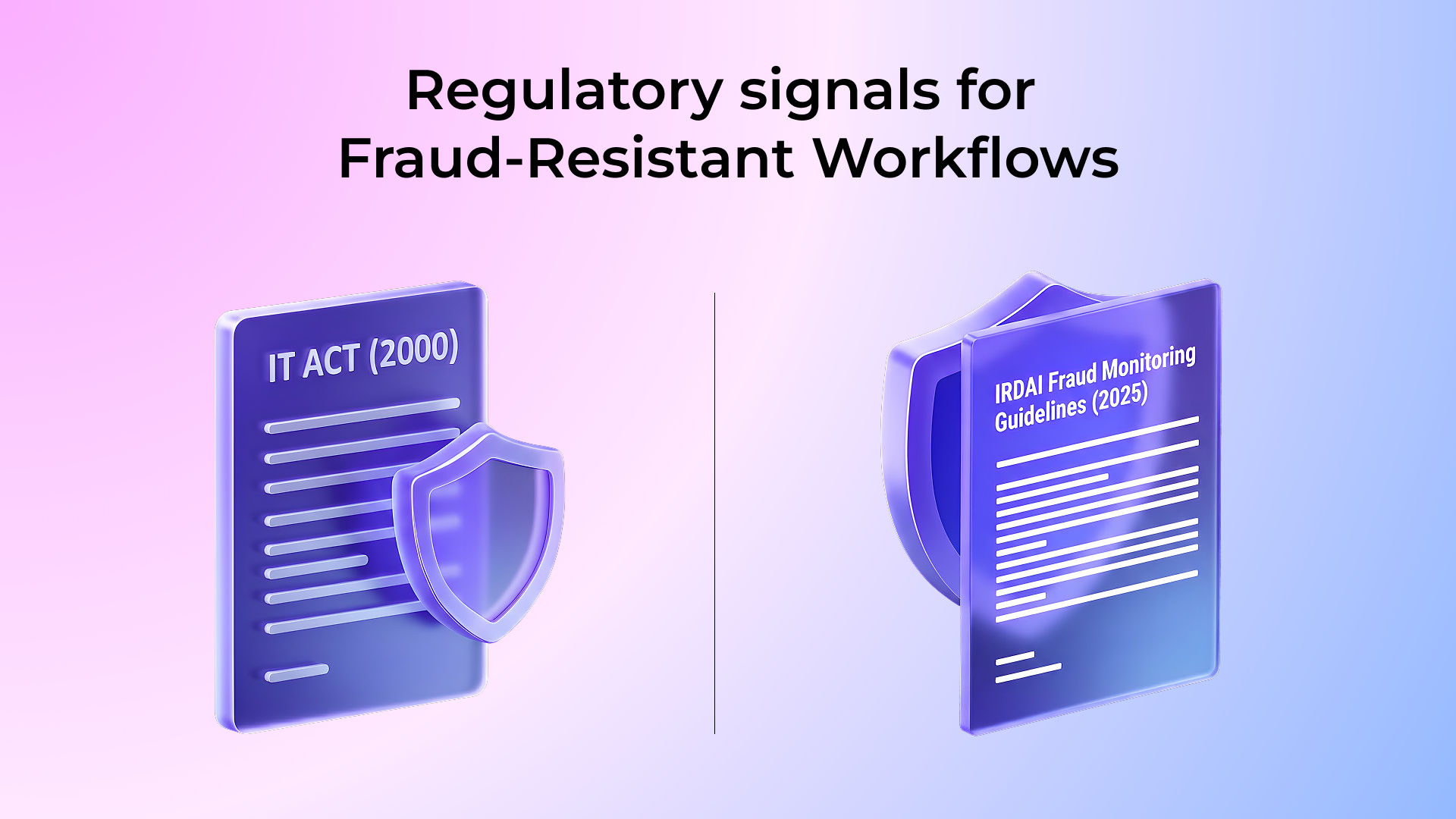
Two regulatory signals matter for insurers building fraud-resistant workflows:
- First, the IT Act provides legal recognition for electronic records and electronic signatures, which supports the move to digitally executed documentation.In higher-risk contexts insurers often lean on DSC-based signing because it provides certificate-linked signer identity, cryptographic integrity, and stronger non-repudiation characteristics for executed documents.
- Second, IRDAI has formalized expectations around fraud risk governance through the Insurance Fraud Monitoring Framework Guidelines, 2025, which come into force on 1 April 2026.
Here are the specific regulatory anchors insurers typically map to while designing tamper-proof e-contracts:
- Legal validity of electronic execution
- Digitally signed insurance policy documents
- Stronger fraud deterrence, detection, and reporting expectations effective April 2026
What Makes e-Contracts Tamper-Proof
“Tamper-proof” is not a single feature. It is a chain of controls that makes alteration obvious, and evidence easy to verify.
Below are the building blocks insurers use to make tamper-proof e-contracts defensible:
- Integrity protection for every final document
Cryptographic hash sealing so any change is detectable, with tamper-evident signatures and final PDF sealing
- Time-linked evidence
Trustworthy time stamps for when a document version existed and was executed
- Version control and chain of custody
Every upload, edit, approval, and share event logged with actor and timestamp
- Signer identity and intent
Strong authentication plus proof of consent and signer actions
- Controlled access
Role-based permissions for viewing, exporting, and re-uploading critical documents
Where Tamper-Proof e-Contracts Sit in the Insurance Lifecycle: High-Leverage Touchpoints
Fraud prevention is most effective when tamper-proofing starts early, not only at claim time. If proposal, issuance, endorsements, and claims are separated, investigations become slower while disputes become louder.
Here is how insurers typically apply tamper-proof e-contracts across the lifecycle:
- Proposal and onboarding
Proposal capture with authenticated acceptance and KYC-linked consent and declarations stored as immutable records
- Policy issuance and endorsements
Electronic policies that are digitally signed and centrally retrievable. Execute endorsements as controlled versions, not editable attachments
- Claims initiation
Claim forms, authorizations, and declarations signed with traceable consent
- Claims settlement
Discharge vouchers and settlement letters executed with final-version integrity
- Dispute resolution and audit
One source of truth for “what was signed,” “when,” and “by whom”
Implementation Checklist for Claims Teams
The goal of making digital contracts tamper-proof is to remove ambiguity. The fastest implementations start with one claim journey and scale once the evidence trail is stable.
Use this rollout sequence to implement tamper-proof e-contracts:
- Define what “proof” must look like
- Evidence package per document type, including:
- signer identity method
- timestamp
- document hash or integrity seal reference
- final signed copy retention location
- Standardize templates before scaling
- Lock templates for proposal, policy schedules, endorsements, claim forms, discharge vouchers
- Build exception handling that doesn’t become a loophole
- Route deviations and overrides for approval with mandatory reason logging
- Test with fraud and dispute scenarios
- Run simulations: version swap attempt, backdated upload, signer denial, altered attachment
- Measure outcomes that both claims and compliance care about
- Reduced dispute handling time
- Faster document retrieval for audits
- Fewer “documentation gaps” in investigations
Conclusion
Summing up, tamper-proof e-contracts help insurers reduce fraud by taking the oxygen away from document manipulation. In other words, fraud is made more difficult, while trust becomes easier.
It’s important to understand that the win is not “paperless for the sake of paperless.” It is having evidence that stands up calmly under pressure: integrity, identity, timestamps, and a complete audit trail.
With electronic signatures recognized in law and IRDAI’s fraud monitoring framework coming into force from 1 April 2026, insurers that treat contract integrity as a core control will be better positioned for faster claims, fewer disputes, and cleaner audits.
Reinforce your contracts for fraud prevention with Doqfy.