
Managing Contract Amendments and Addenda Without Losing Audit History
This guide explains how to manage contract amendments and addenda while preserving audit history through controlled versioning, change summaries, rule-based approvals, tamper-evident execution, and linked storage, providing a practical workflow and governance checklist for a defensible audit trail.
Most enterprise contracts change over time.
Pricing adjustments, scope expansions, revised service levels, regulatory clauses, and updated renewal terms often require formal amendments or addenda.
The challenge is maintaining traceability as these changes accumulate. Without disciplined change management, teams can lose visibility into which version is binding, why certain deviations were accepted, and how approvals were obtained.
This article outlines a structured approach to managing contract amendments and addenda while preserving audit history, execution integrity, and operational clarity.
Why Audit History is Lost During Contract Amendments
Audit history is typically lost when contract changes are handled as isolated documents rather than as governed lifecycle events. Common breakdown points include:
Overwriting the Original Record
Executed amendments are uploaded as replacements, removing context from the base agreement.
Approvals Captured Outside the Workflow
Key decisions occur over email or messaging tools with limited traceability.
Parallel Copies Across Teams
Legal, procurement, and finance retain separate versions, creating uncertainty about the current terms.
Obligations Not Refreshed After Changes
Notice periods, SLAs, payment milestones, or renewal dates change, but operational tracking remains outdated.
A Controlled Lifecycle for Contract Amendments and Addenda
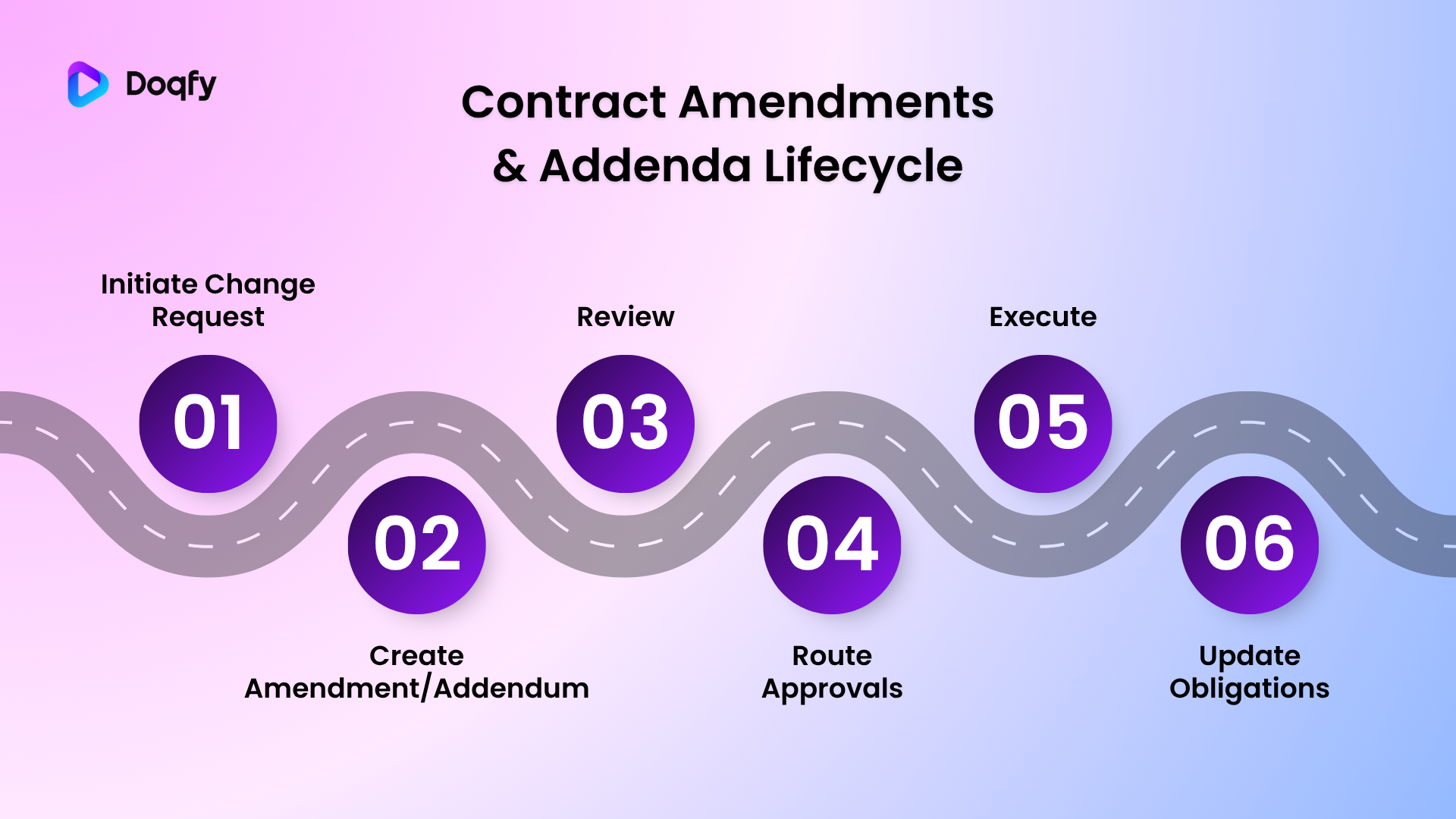
A reliable approach is to treat every amendment or addendum as a governed workflow linked to the master agreement.
This preserves lineage while enabling faster reviews and predictable approvals.
Below is a lifecycle model that protects audit history end-to-end:
Initiate a Change Request
Capture owner, rationale, impacted clauses, and proposed effective date.
Create the Amendment/Addendum from Approved Templates
Standardize structure and ensure consistent references to the base agreement.
Review Within a Single Collaboration Thread
Consolidate comments and redlines to avoid fragmented negotiation trails.
Route Approvals Using Rules
Escalate based on value, risk category, or deviation type.
Execute with Traceable Evidence
Ensure the executed copy is identifiable, time-stamped, and tamper-evident.
Update Obligations and Downstream Workflows
Refresh renewal triggers, billing schedules, SLA measures, and reporting.
Versioning Principles that Preserve Audit History
Dispute prevention often comes down to one operational capability: proving which version applies.
Establishing clear versioning principles reduces ambiguity for both internal stakeholders and external counterparties.
Use the following rules to maintain defensible version history:
Keep a Persistent Master Agreement Record
The base agreement remains the anchor record throughout its life.
Store Each Amendment/Addendum as a Linked Record
Maintain clear cross-references, effective dates, and status tracking.
Generate A Standard Change Summary
Document what changed, which clauses were affected, and the commercial impact.
Use Lineage Rather Than Replacement
Track supersession through explicit links (e.g., “Amendment 2 supersedes Amendment 1”) instead of overwriting files.
Approval Governance that Supports Speed and Control
Approvals are often seen as the primary cause of delays.
In practice, delays typically come from unclear escalation rules and repeated rework. A structured approval model improves both turnaround time and auditability.
A practical approval design includes:
A Deviation Matrix
Define which clauses are locked, negotiable with fallbacks, or always escalated.
Rule-Based Routing
Route based on contract type, value, counterparty category, and deviation severity.
Rationale Capture for Exceptions
Store the reason for approving non-standard positions, not only the approval itself.
Time-Bound Review Loops
Use reminders and escalation paths to keep reviews predictable.
Execution and Storage Patterns that Prevent Audit Loss
Strong governance can still fail if execution and storage are inconsistent. The goal is to ensure executed changes remain verifiable, immutable, and easy to retrieve.
Below are execution and storage patterns that preserve audit history:
Reference the Base Contract in the Executed Change
Include the base agreement identifier and clearly state the effective date.
Store Executed Documents As Immutable Artifacts
Lock the signed version and preserve integrity through tamper-evident controls.
Maintain A Complete Activity Log
Track creation, edits, approvals, signing events, downloads, and shares.
Maintain A Consolidated “Current Terms” View
Provide operational teams a reliable summary of the latest obligations and key terms, while preserving historical versions.
Conclusion
Summing up, managing contract amendments and addenda without losing audit history requires a repeatable operating model: keep the master agreement as the anchor, link each change as a separate record, enforce versioning and approval rules, and store executed copies with clear evidence trails.
Over time, this reduces ambiguity, supports audit requirements, and improves the reliability of downstream operations that depend on current contract terms.
Ensure version history is retained across contracts with the right CLM tool. Book a demo with Doqfy today.