
Logistics and Supply Chain Contracts in India: Managing SLAs, 3PL Agreements, and Penalty Clauses
Logistics and 3PL contracts in India turn on SLAs, liability, and penalties. Under Section 74, penalty clauses are a compensatory ceiling, not an automatic payout, and liability caps cannot exclude fraud or fundamental breach. Standardize these terms with audit-ready execution.

Where the Real Risk in Logistics Lives
In logistics, the goods move fast and the money moves faster, but the risk sits in the contract. A missed delivery window, damaged cargo, a warehouse shortfall, or a provider that walks away mid-peak-season can each turn into a dispute, and when that happens, the agreement is what decides who pays.
Logistics and supply chain contracts in India cover a range of relationships: third-party logistics (3PL) arrangements, transportation and carriage, warehousing, and freight forwarding, often stitched together under master supply or service agreements. What they share is a dependence on three things being drafted correctly: service levels, liability, and penalties. Get those right and the relationship is manageable. Get them wrong and a well-run operation can still carry unenforceable agreements.
Why Logistics Contracts Need Special Care in India
1. Service levels are the contract, not a schedule
In logistics, the SLA is not an annexure, it is the heart of the deal. On-time-in-full delivery, turnaround times, fill rates, damage thresholds, and reporting cadence define what good performance means. If these are vague, every performance dispute becomes an argument about expectations rather than a check against agreed numbers.
2. Penalty clauses are limited by Section 74
Logistics contracts lean heavily on penalties and liquidated damages for delays and shortfalls, and Indian law shapes exactly how far these go. Under Section 74 of the Indian Contract Act, 1872, a stipulated sum operates as a ceiling, not an automatic entitlement. Courts award reasonable compensation not exceeding the named amount, and the claimant generally has to show that some loss was actually suffered. A penalty number in the contract is a limit on recovery, not a guaranteed payout, so it should be a genuine pre-estimate of likely loss.
3. Limitation of liability protects providers, within limits
Providers routinely cap liability, often at a value tied to fees, and exclude indirect or consequential losses. Indian courts have upheld such caps, including liability limits printed on consignment notes. But parties generally cannot exclude liability for fraud, willful misconduct, or fundamental breach, and caps that are arbitrary, unconscionable, or imposed through unequal bargaining power can be struck down.
4. Carrier liability has its own rules
For the movement of goods, carriage-specific law applies. A carrier's liability for goods entrusted to it is treated strictly, and while a carrier can limit liability by special contract, it remains liable for loss caused by its own negligence or that of its agents. Carriage of goods by road is also governed by dedicated legislation, so transportation terms should be drafted with that backdrop in mind.
The Core Elements of a Strong Logistics or 3PL Contract
- Scope of services. Precisely what the provider will do: transport, storage, handling, value-added services, and geographies.
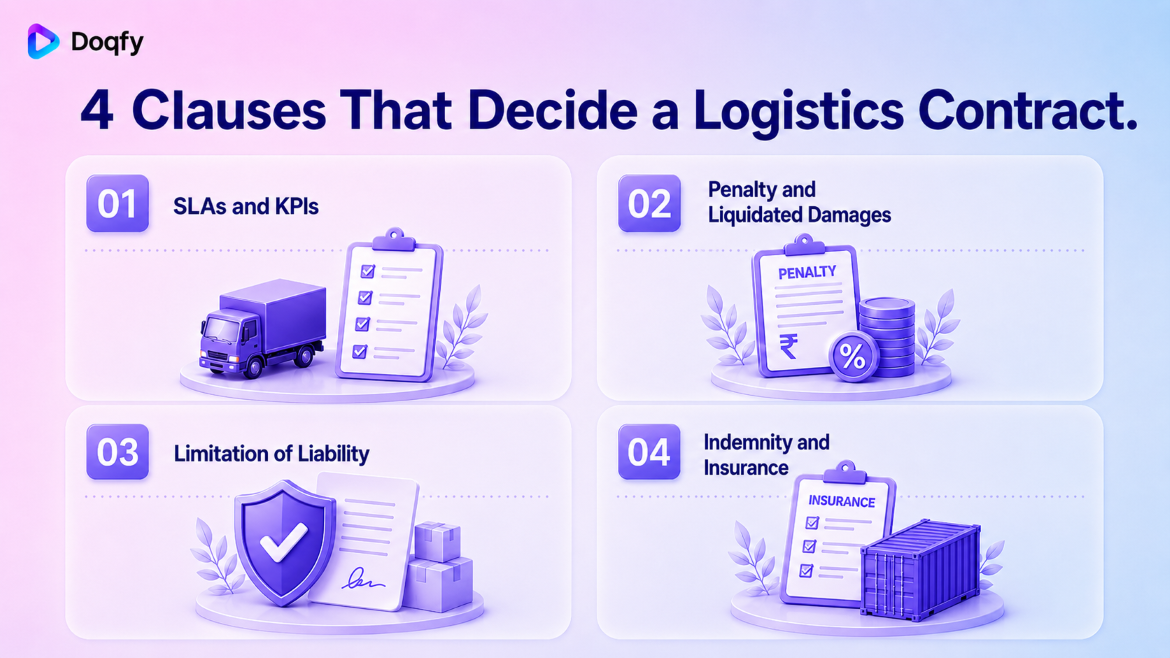
- Service levels and KPIs. Measurable targets such as on-time delivery, fill rate, damage and shrinkage limits, and reporting, with a clear method of measurement.
- Penalty and service-credit mechanics. Consequences for missing SLAs, drafted as reasonable pre-estimates in line with Section 74, with clear trigger events.
- Limitation of liability. A reasonable cap with explicit carve-outs, respecting the limits Indian courts place on excluding liability.
- Indemnity. Allocation of third-party claims, which sits on a separate statutory footing from breach damages.
- Insurance, risk, and title. Who insures the goods, when risk and title pass, and how claims are handled.
- Force majeure and business continuity. What excuses performance, and what the provider must still do during disruption.
- Compliance and data. GST and e-way bill obligations, tracking and data-sharing terms, and, for cross-border movement, Incoterms.
- Term, renewal, and exit. Duration, renewal triggers, and a transition plan so a provider exit does not strand the operation.
How to Manage Logistics Contracts at Scale
1. Standardize templates by contract type
Maintain controlled 3PL, transportation, warehousing, and master supply templates so SLAs, penalties, and liability terms are consistent rather than renegotiated from scratch each time.
2. Make penalty and liability clauses defensible by default
Bake the Section 74 principle into your templates: penalties as genuine pre-estimates, liability caps with lawful carve-outs. This keeps clauses enforceable instead of merely aspirational.
3. Track SLAs and obligations, not just signatures
The value in a logistics contract is realized after signing, through SLA performance, renewals, and insurance and compliance obligations. Track these actively rather than filing the contract away.
4. Execute and store with an audit trail
Use electronic signatures recognized under the IT Act, 2000 for fast execution, and keep every agreement, amendment, and approval in a central, permissioned repository so disputes can be resolved against a clear record.
India Guardrails for Logistics Contracting in 2026
- Draft penalties as pre-estimates. Section 74 makes the stipulated sum a ceiling, and reasonable compensation with proof of loss is the standard, so penalty clauses should reflect genuine expected loss.
- Keep liability caps lawful. Do not attempt to exclude fraud, wilful misconduct, or fundamental breach, and keep caps proportionate to avoid being struck down.
- Mind carriage law. Transportation terms interact with carriage-specific legislation and carrier-liability principles, so limitation clauses should be drafted accordingly.
- Build compliance in. GST, e-way bill, and, for cross-border trade, Incoterms and documentation should be part of the contract, not managed separately.
This blog is general information and not legal advice. Have qualified counsel review your logistics agreements against your operations and risk profile.
Conclusion
Summing up, logistics and supply chain contracts are won or lost at the level of service standards, liability, and penalties. In India, penalties are capped and compensatory under Section 74, liability caps are enforceable only within limits, and carriage law adds its own layer. A well-run supply chain deserves contracts drafted to match.
The organizations that handle this well treat logistics contracting as a governed system: standardized templates by contract type, SLA and penalty clauses that hold up, active obligation tracking, and audit-ready execution stored in one place. That is what turns a fast-moving operation into one that is also defensible.
Explore audit-ready logistics and supply chain contract workflows with Doqfy today!
Sources and References
- The Indian Contract Act, 1872, Sections 73 and 74 on damages and liquidated damages (India Code, Government of India): https://www.indiacode.nic.in/handle/123456789/2187
- Liquidated damages in a contract, Section 74 principles and case law (iPleaders): https://blog.ipleaders.in/liquidated-damages-in-a-contract/
- Limiting risk: drafting liquidated damages, indemnities, and liability caps in India (Alaya Legal): https://alayalegal.com/articles/limiting-risk-drafting-lds-indemnities-and-liability-caps-in-india/
- Limitation of liability clauses in Indian contracts and negotiation reality (Mondaq): https://www.mondaq.com/india/contracts-and-commercial-law/1723510/limitation-of-liability-clauses-in-indian-contracts-where-negotiation-deadlocks-meet-judicial-reality
- Law of damages in India, analysis of Sections 73 and 74 and carrier liability (Nishith Desai Associates): https://www.nishithdesai.com/fileadmin/user_upload/pdfs/Research_Papers/Law_of_Damages_in_India.pdf
- The Carriage by Road Act, 2007 (India Code, Government of India): https://www.indiacode.nic.in/handle/123456789/2015
- The Information Technology Act, 2000, on legal recognition of electronic signatures and electronic records (India Code / MeitY)