
E-Signature Adoption in BFSI, Healthcare, and Government: What Changes in 2026
In 2026, e-signature adoption in India rises across BFSI, healthcare and government for faster execution and audit trails. Success needs eSign or DSC, identity + consent controls, tamper-evident records, and alignment with RBI digital lending and ABDM consent norms.
E-Signature Adoption Is Entering Its Scale Phase
Today, e-signature adoption in India is less about proving that digital signing works, and more about making it consistent, secure, and audit-ready across high-volume operations.
BFSI teams want faster loan and account workflows with cleaner documentation. Healthcare needs consent-first records that hold up under scrutiny. Government departments need citizen-facing services that reduce paper handling and queue time without weakening verification.
The legal foundation is already in place. India’s Information Technology Act, 2000 provides legal recognition for electronic signatures when used as prescribed.
What’s Driving e-Signature Adoption Across India
The shift is coming from both sides: teams want faster execution, and governance teams want cleaner proof. These drivers show up consistently across industries, and they’re the reason adoption is scaling beyond pilots.
- Operational volume
- Contracts, forms, and approvals are multiplying across branches, apps, partners, and third parties.
- Digital signing reduces physical touchpoints and accelerates turnaround times.
- Governance expectations
- Stakeholders want traceability: who signed, what version they signed, when it happened, and what identity checks were used.
- Mature national rails
- India’s eSign ecosystem is facilitated via licensed Certifying Authorities under the IT Act, with e-KYC based authentication and privacy-preserving design (hash-based signing rather than sending the full document for signing).
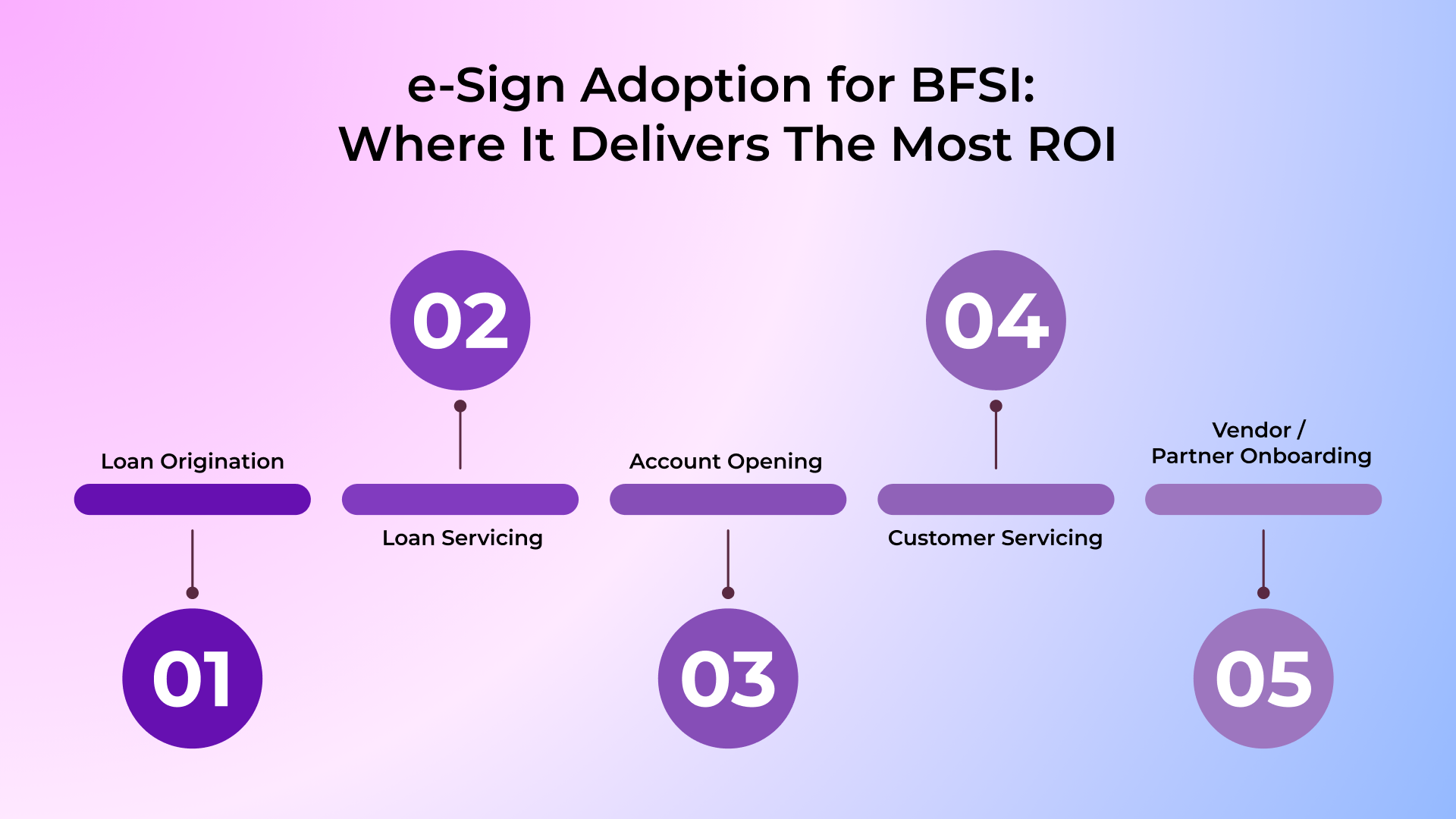
E-signature Adoption in BFSI
BFSI sees the quickest returns because volumes are high and the paper trail is expensive to manage. At the same time, scrutiny is higher, so adoption works best when execution and evidence are designed together.
- Loan origination and servicing
- High-volume documents (application forms, KFS acknowledgements, loan agreements, mandates) benefit immediately from standardised signing flows.
- RBI’s Digital Lending Directions, 2025 reinforce stronger discipline around digital lending governance and documentation in RE-LSP arrangements, which makes audit-ready execution workflows a practical priority.
- Account opening and customer servicing
- Digital forms, declarations, and service requests move faster when signing is integrated into the journey rather than treated as a last-step add-on.
- Vendor and partner onboarding
- SLA execution, compliance declarations, and renewal cycles become easier to manage when signed copies and audit trails live in one system.
- E-signature adoption in BFSI: Key control metrics
Speed is valuable, but only when the signing trail is defensible. These controls are the usual “non-negotiables” for BFSI teams designing audit-ready e-signature flows.
- Signer identity and intent
- Tamper-evident final signed document
- Time-stamped evidence trail
- Role-based access and approvals for exceptions
E-Signature Adoption in Healthcare
Healthcare adoption is shaped by one core requirement: the ability to prove consent and protect sensitive records. Digital signing helps, but the real value comes from making patient-facing and internal processes easier to verify later.
- Patient consent and data sharing workflows
- Healthcare is not only about signing forms. It is about proving consent and controlling access to sensitive health data.
- ABDM emphasizes explicit and informed consent for sharing health records, which aligns naturally with structured digital consent and verifiable electronic records.
- Hospital operations and insurance coordination
- Admission and discharge documentation, TPA workflows, and policyholder declarations become smoother when signatures are collected remotely and stored centrally.
- Clinical administration
- Internal approvals, staff acknowledgements, and protocol sign-offs can move to digital signing with clear audit trails.
- E-signature adoption in healthcare: What to get right early
Healthcare workflows scale quickly once a few foundational choices are made correctly. Get these right early, and you reduce rework, disputes, and audit pain later.
- Consent capture should be unambiguous
- Who consented
- What they consented to
- For what purpose and duration
- Access should be role-bound
- Limit who can view, export, and share signed documents
- Retention and retrieval should be fast
- Healthcare audits do not enjoy treasure hunts
E-Signature Adoption in Government
Government adoption can scale rapidly because use cases are broad and citizen-facing, but standardisation is what makes it sustainable. The goal is consistent templates, predictable approvals, and clean evidence trails across departments.
- Citizen services
- Forms, declarations, and applications become simpler when citizens can sign digitally without visiting offices for basic attestations.
- Inter-department approvals
- File movement improves when sign-offs happen in sequence with visible timestamps and ownership.
- Vendor contracts and procurement
- Tender documentation, work orders, and payment-linked milestones become easier to track when signing is integrated into the procurement workflow.
- E-signature adoption in government: Common friction points to plan for
- Legacy formats and inconsistent templates
- Multiple approving authorities
- Mixed identity modes across states and departments
How to Implement e-Signature Adoption that Stands Up to Audits
Audit-ready adoption is built through repeatable controls, not one-off best efforts. This sequence helps teams move fast while keeping evidence, identity, and integrity tight from day one.
- Choose the signature mode based on risk and use case
- For high-stakes or specific regulatory contexts, you may need stronger identity assurance.
- For high-volume citizen or customer workflows, speed and accessibility become important.
- Define an evidence checklist and enforce it
- Authentication method
- Time stamp
- IP and device context where applicable
- Document hash and tamper evidence
- Final signed copy delivery and storage
- Design exceptions so they do not become loopholes
- Route deviations for approvals
- Log who approved the exception and why
- Standardise templates before you scale
- E-signature adoption fails quietly when every team uses a different format and calls it “standard”
- Measure outcomes that business and compliance both care about
- Cycle time reduction
- Drop-off rate during signing
- Rework due to incorrect data or missing steps
- Audit retrieval time for signed documents
Conclusion
Summing up, e-signature adoption across BFSI, healthcare, and government in 2026 is moving beyond digitising signatures and into operationalising trust. The winning programmes treat signing as a controlled workflow with identity, consent, and auditability baked in. India already recognizes electronic signatures in law, and the national eSign ecosystem is designed for secure, privacy-preserving digital signing.
If you align signature type to use case, enforce a clean evidence trail, and standardise templates before scaling, e-signature adoption becomes a reliable foundation for faster services, safer compliance, and calmer audits.
Switch to eSigning trusted by 1000+ clients across India. Try Doqfy today.