
Contract Risk Scoring Frameworks For Enterprise Compliance Teams
This blog helps enterprise compliance teams build a contract risk scoring framework that converts legal and operational risk into measurable signals, covering scoring dimensions, methods, thresholds, approvals, evidence, audit trails, and monitoring aligned with ISO 31000 and Indian regulations.
A Contract Risk Scoring Framework helps compliance teams replace subjective judgement with consistent decisioning.
Today, this matters more because enterprise contracting is faster, more distributed across teams, and increasingly tied to third-party delivery, data access, and regulatory exposure.
A scoring framework does not remove legal review. It helps prioritize it, route approvals intelligently, and create an audit-ready record of how risk was assessed and accepted.
Why Enterprise Teams Need Contract Risk Scoring Frameworks Now
Compliance teams usually feel the pressure in two places: onboarding velocity and audit scrutiny.
A scoring model creates a shared language between Legal, Risk, Procurement, Security, and the business.
Here are the most common triggers for implementing a framework:
Higher Vendor And Partner Density
More third parties means more variability in terms, controls, and evidence quality.
Regulated Expectations Around Outsourcing Governance
Indian regulated entities face explicit expectations on outsourcing risk management, including governance, due diligence, and control of outsourced activities.
Accountability Does Not Shift With Outsourcing
For digital lending ecosystems, RBI reiterates that outsourcing arrangements do not dilute the regulated entity’s responsibility, which increases the need for consistent contractual controls.
Contract Risk Scoring Frameworks: Core Design Principles
The best scoring frameworks follow standard risk management thinking: define risk criteria, assess consistently, treat risk with controls, and monitor continuously.
ISO 31000 is often used as a reference point for building that repeatable approach.
To keep the model usable across business units, anchor it to these principles:
Explainability Over Complexity
Stakeholders should understand why a contract scored “High” without needing a spreadsheet tour.
Controls Are Part Of The Score
Risk should reduce when the right protections exist, not only when someone feels comfortable.
Thresholds Must Trigger Actions
A score without routing, approvals, and evidence requirements becomes reporting noise.
Risk Dimensions That Matter In Enterprise Contracts
To make the framework consistent, define a small set of dimensions that cover most enterprise exposure. Then map them to measurable indicators.
Below are common dimensions used by compliance teams:
Counterparty Criticality
Whether the vendor supports core operations, customer journeys, regulated functions, or critical infrastructure.
Data Exposure
What data types are accessed, processed, or stored, and whether cross-border processing is involved.
Operational Dependency
How difficult it is to switch providers, and whether delivery failure creates business continuity risk.
Contractual Protections
Strength of liability, indemnity, audit rights, subcontracting restrictions, and termination and exit terms.
Regulatory And Reputation Impact
Likelihood the relationship could trigger regulatory findings, customer harm, or public incidents.
Contract Risk Scoring Frameworks: Example Scoring Approach
Most teams use a simple 1 to 5 scoring scale per dimension, with weights based on business context. Keep the math straightforward so the model can be applied consistently.
A practical structure looks like this:
Assign A Base Score Per Dimension (1-5)
Example: Data exposure might score 5 for highly sensitive data access and 2 for non-sensitive operational data.
Apply Weights For What Matters Most
Example weights: Data exposure 30%, criticality 25%, contractual protections 20%, operational dependency 15%, regulatory impact 10.
Apply Control Credits Where Protections Are Strong
Example: Reduce risk where breach notification timelines are strict, audit rights are enforceable, and exit clauses are clear.
Turning Contract Scores Into Approval And Control Flows
A scoring framework becomes valuable when it controls the workflow. This is where compliance teams earn cycle-time improvements without reducing governance.
Use the score to trigger actions like:
Approval Routing By Threshold
- Low risk: Standard workflow with template adherence
- Medium risk: Legal and Security review if certain clauses deviate
- High risk: Senior risk sign-off, plus mandatory evidence and tighter monitoring
Clause Guardrails By Risk Tier
High-risk contracts require stronger positions on audit rights, subcontracting, breach notification, and termination assistance.
Evidence Requirements By Risk Tier
Require documented due diligence, certifications, insurance, and periodic attestations for higher tiers.
Post-Sign Monitoring By Risk Tier
Higher risk means stricter SLA reporting, incident response commitments, and renewal governance.
Implementation Steps For Compliance Teams
Most rollouts succeed when they start with one high-volume contract lane and expand once scoring is stable.
Follow this sequence to implement without disrupting business teams:
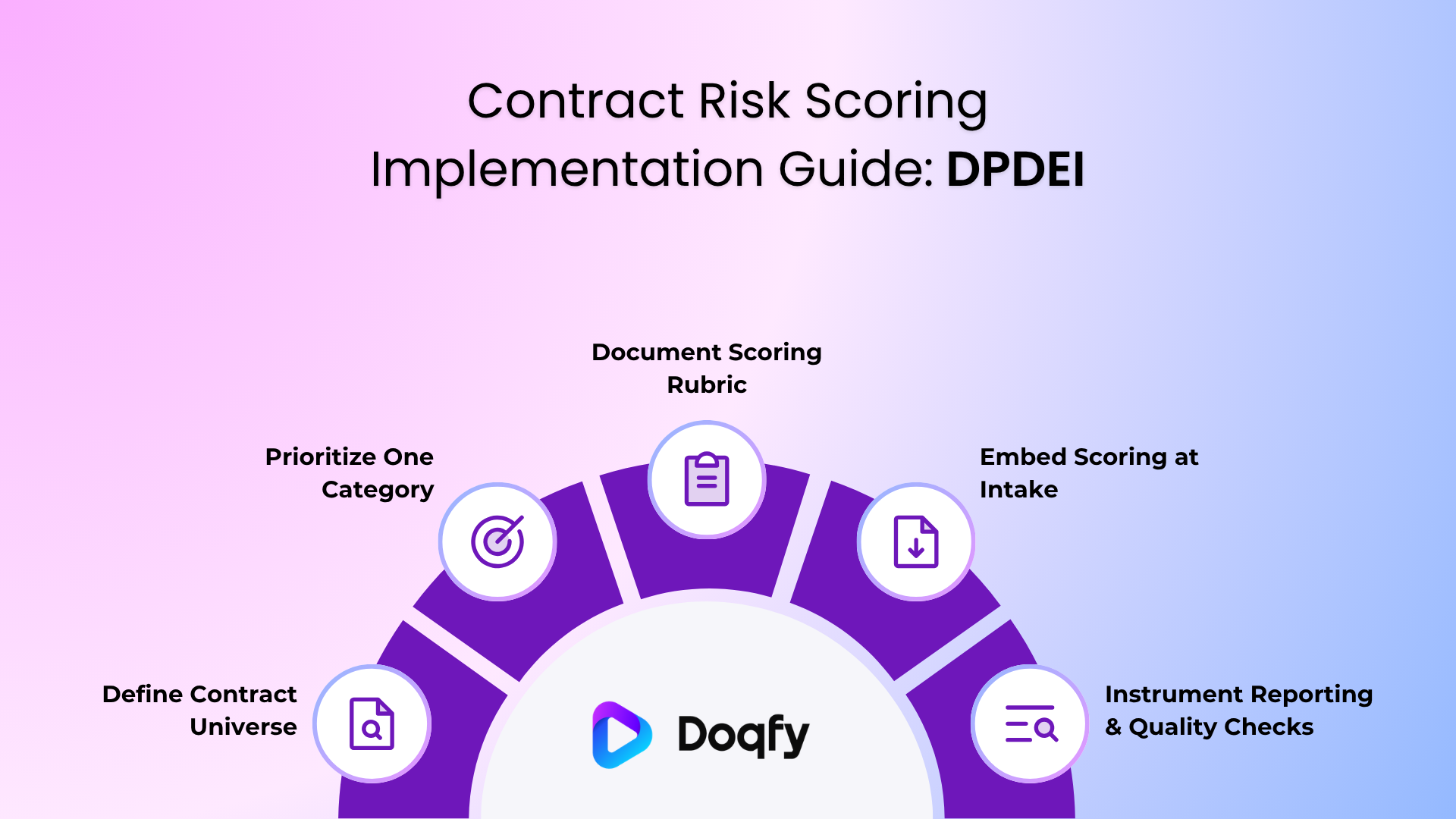
Define The Contract Universe And Prioritize One Category
Vendor MSAs, IT services, payments partners, or data-processing vendors are common starting points.
Document The Scoring Rubric And Examples
Provide 5–10 examples of real contracts and how they would score, so teams calibrate quickly.
Embed Scoring At Intake
Capture key signals at request stage, before negotiation begins.
Link Scoring To Templates And Clause Libraries
Standard terms should auto-apply based on tier, reducing manual negotiation.
Instrument Reporting And Quality Checks
Track override rates, rework rates, and approval turnaround times to refine the model.
Conclusion
Summing up, Contract Risk Scoring Frameworks help enterprise compliance teams scale governance without creating friction.
They make risk decisions consistent, connect risk to contractual controls, and create an audit-ready trail of how exceptions were handled.
When aligned to established risk management principles and regulatory expectations around outsourcing accountability, the framework becomes a practical operating layer, not an academic exercise.
When used correctly, contracts can be a prominent tool in reducing business risk overall.
Book a demo with Doqfy to explore CLM that helps avoid legal exposure.