
Contract Data Visibility For CFO-Level Financial Forecasting
This blog explains how contract data visibility enables CFO-level financial forecasting by converting contract text into structured signals. It covers key contract fields, a contract-to-forecast data model, versioning controls, and dashboards linking renewals, obligations, and penalties to outcomes.
For many finance teams, forecasting still depends on spreadsheets, emails, and “someone from Procurement confirming the latest MSA.” That approach works until contracts scale across business units, renewals overlap, and commercial terms start shifting mid-year. Contract Data Visibility changes forecasting from assumption-driven to evidence-driven by turning agreements into structured inputs for planning, reviews, and risk controls.
When contract data is searchable, standardized, and current, the CFO’s view improves across revenue predictability, cost commitments, renewal exposure, and downside risk.
Why Contract Data Visibility Matters For CFO-Level Forecasting
Contracts are not only legal artifacts. They are operating instructions for cash flows, pricing, penalties, termination rights, and obligations that impact the P&L and balance sheet. Without visibility, finance teams miss changes until they show up as variance.
Two patterns typically trigger the push for better visibility:
- Contracts are distributed across teams and systems, so no one has a complete view of commitments.
- Renewals, escalations, and addenda alter the forecast, but the updated terms are not reflected in finance cycles.
Contract Data Visibility Starts With Identifying Forecast-Relevant Terms
Not every clause needs to be modeled for finance. CFO-level forecasting improves fastest when teams focus on terms that change revenue timing, cost timing, and risk exposure.
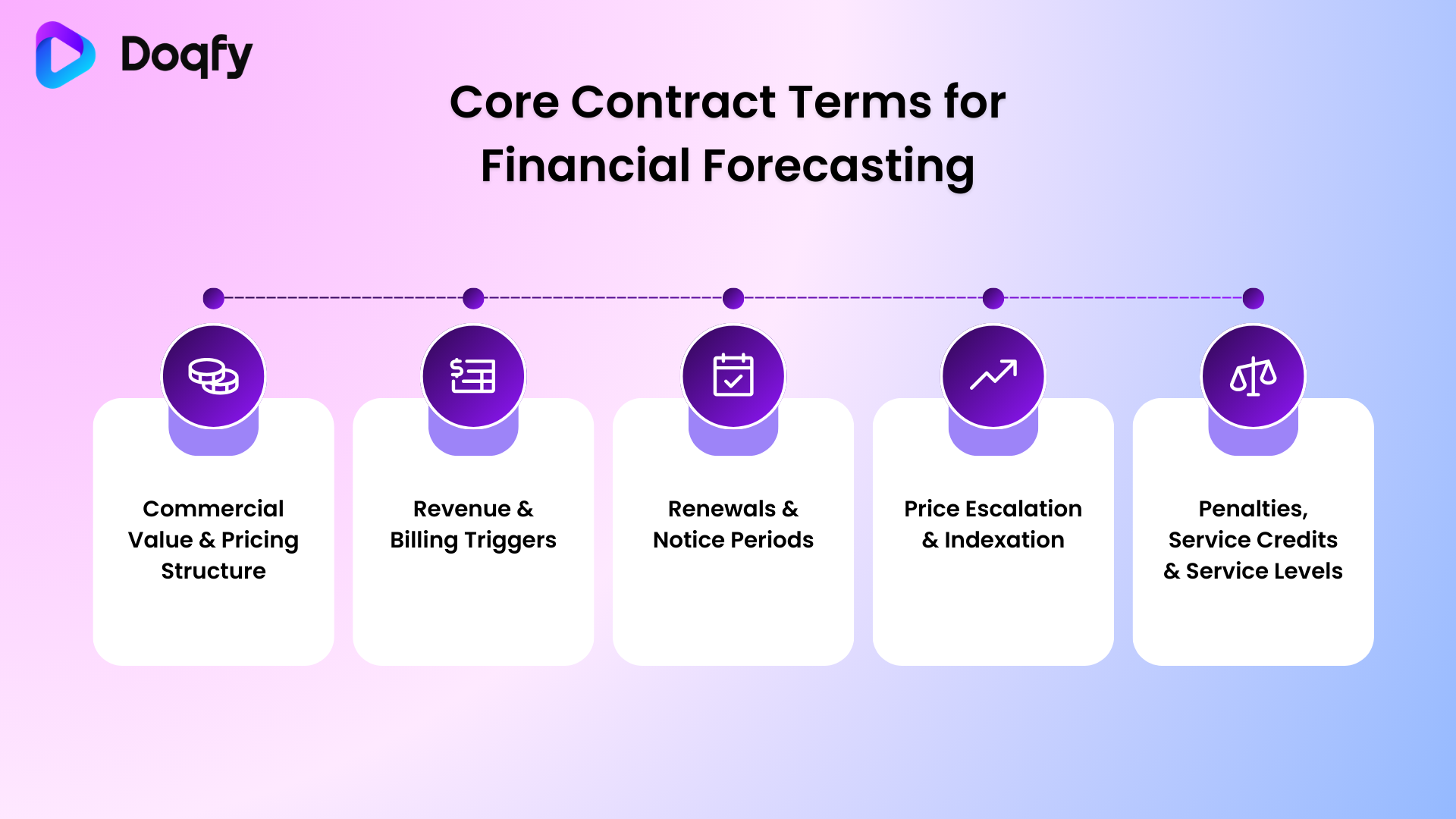
Here are the contract fields that most directly influence forecasts:
Commercial Value And Pricing Structure
Includes unit pricing, minimum commits, tiers, discounts, and usage-based components.
Revenue And Billing Triggers
Identifies when invoicing starts, milestone-based billing, acceptance criteria, and payment schedules.
Renewal, Auto-Renewal, And Notice Periods
Drives pipeline confidence, churn exposure, and renegotiation windows.
Price Escalation And Indexation Clauses
Impacts margin planning and multi-year projections.
Penalties, Service Credits, And SLA-Linked Deductions
Converts operational performance into measurable downside.
Termination Rights And Exit Costs
Influences scenario planning and contingency reserves.
Key Obligations With Financial Impact
Includes reporting requirements, implementation commitments, and deliverables that change cost-to-serve.
How Contract Data Visibility Improves Forecast Accuracy In Practice
Visibility becomes valuable when it changes how forecasts are built and reviewed. This happens when contract data feeds planning cycles as a controlled dataset, rather than being pulled ad hoc when someone asks for it.
Below are the most common CFO-level improvements teams see:
Cleaner Baselines For Cost Forecasting
Vendor commits, renewal dates, and escalation terms reduce surprise spend.
Higher Confidence In Revenue Timing
Acceptance criteria and milestone triggers reduce uncertainty in when revenue can be recognized or billed.
Earlier Signals On Renewal Exposure
Notice windows and renewal calendars move risk detection upstream.
Stronger Variance Explanations
When a forecast shifts, finance can tie the change back to the specific contract update or addendum.
Better Scenario Planning
Termination rights, step-in clauses, and minimum commitments make “what-if” planning more realistic.
Building A Contract-To-Forecast Data Model Without Overengineering
The goal is a model that business teams can maintain and finance teams can trust. It should be structured enough to drive dashboards, and simple enough to survive real operations.
Before you build dashboards, define a consistent data model:
A Standard Contract Record Schema
Fields should cover counterparty, business unit, contract type, value, term dates, renewal type, and owner.
A Finance Impact Layer
Tag which terms impact revenue timing, cost commitments, penalties, and termination exposure.
A Single Source Of Truth For “Current Terms”
The latest effective terms must be clear, especially after amendments and addenda.
Controls For Data Quality
Use validation rules so critical fields are not left blank or entered inconsistently.
Contract Data Visibility Depends On Amendment And Addendum Governance
Forecasting breaks when contract history is unclear. If teams overwrite signed documents or store changes as loose attachments, finance cannot confidently determine which terms apply.
To keep forecasting reliable, contract change management should enforce:
Linked Lineage For Every Change
Amendments and addenda are stored as linked records with effective dates, not replacements.
Change Summaries For Finance-Relevant Updates
When pricing, term, renewal, or penalties change, the change summary should reflect it explicitly.
Approval And Audit Trails For Material Changes
Material commercial deviations should carry a traceable approval record.
Key Metrics for CFOs with High Data Visibility
Dashboards are helpful only when they answer finance questions quickly and credibly. The strongest views are aligned to operating rhythms: month-end, quarter-end, renewal planning, and budget reviews.
Here are dashboard views that typically deliver value:
Renewals And Notice Windows By Quarter
Shows exposure concentration and workload planning.
Committed Spend And Escalation Outlook
Surfaces upcoming increases and minimum commitments.
Revenue Milestones And Acceptance Dependencies
Highlights revenue at risk due to delivery or acceptance delays.
Penalty And SLA Exposure
Connects service performance to potential credits or deductions.
Contract Concentration And Counterparty Risk
Identifies over-dependence on a small number of vendors or customers.
Conclusion
Summing up, Contract Data Visibility strengthens CFO-level financial forecasting by turning agreements into structured, trustworthy inputs for planning and review cycles.
When commercial terms, renewals, obligations, and change history are visible and current, finance teams can reduce variance, improve scenario planning, and respond faster to shifts in revenue and cost exposure.
Doqfy is a contract lifecycle platform that helps teams structure key contract terms and keep them current, so finance can forecast with reliable inputs. Explore Doqfy for your enterprise today.