
CLM in Bulk: Executing Hundreds of Agreements Without Chaos
A practical guide to managing bulk contract execution with contract lifecycle management software. Covers how enterprises can handle high agreement volumes with better workflows, approvals, execution control, and visibility across the contract lifecycle.

Introduction
Bulk execution sounds efficient in theory.
In practice, it often turns into a slow-moving pile-up.
A business may need to send out hundreds of agreements across employees, vendors, customers, channel partners, or franchisees.
The document may be standard, but the process doesn’t always tend to be.
Versions start splitting. Approvals get delayed. Signatures come in unevenly. Stamping gets missed.
Tracking becomes manual.
Soon, the real problem is no longer drafting. It is coordination.
A strong contract lifecycle management software setup does not just help enterprises store contracts.
It helps them move high volumes of agreements through a controlled process without losing visibility.
This blog looks at how enterprises can use CLM to execute agreements in bulk with more speed, consistency, and control.
Why Bulk Contract Execution breaks down so easily
Bulk execution is usually treated as a document problem. It is actually a workflow problem.
When one contract becomes one hundred, small inefficiencies multiply fast.
The issue is not simply sending more agreements. It is managing movement across the lifecycle.
That includes who receives which version, who approves what, who has signed, what is pending, and what still needs to be completed before the agreement is fully valid and retrievable.
Without that visibility, enterprises start relying on manual follow-ups, spreadsheets, inbox searches, and last-minute coordination.
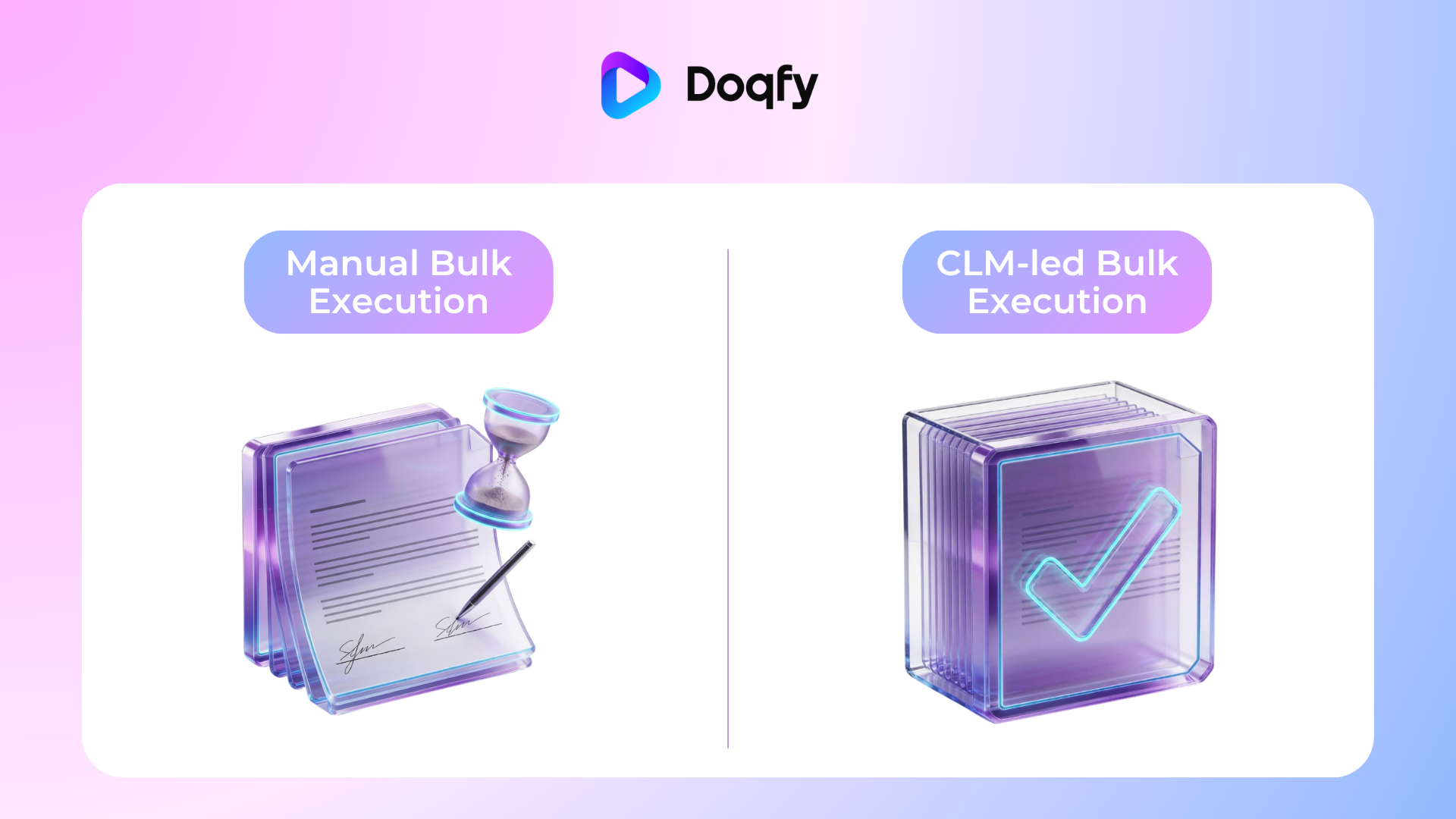
What enterprises should automate first in bulk workflows
1. Standardized drafting
- Bulk execution works best when document preparation starts from approved templates.
- Standardization reduces variation across agreements.
- It also lowers the risk of outdated language being used at scale.
2. Approval routing
- High-volume execution cannot depend on manual email chains.
- Approval workflows should move documents to the right stakeholders based on value, function, or agreement type.
- This keeps batches moving without constant intervention.
3. Execution steps
- Signing, stamping, and related pre-execution checks should not happen in disconnected systems.
- The more handoffs a team has to manage, the more likely the process is to slow down.
- CLM should reduce those jumps.
4. Status tracking
- Teams should be able to see what is drafted, what is approved, what is signed, and what is pending.
- This is one of the biggest operational advantages of contract lifecycle management software in bulk use cases.
5. Post-sign retrieval and follow-up
- Once agreements are executed, they should not disappear into folders.
- Contract management software should make retrieval, renewal tracking, and obligation visibility easier from day one.
Where Doqfy Helps in High-Volume Execution
When agreement volume increases, control matters just as much as speed.
At Doqfy, we focus on the parts of contract execution that usually become messy first when teams start operating in bulk.
That means helping enterprises keep movement structured, execution compliant, and visibility intact across the lifecycle.
Doqfy uses
- Standardized templates and controlled drafting
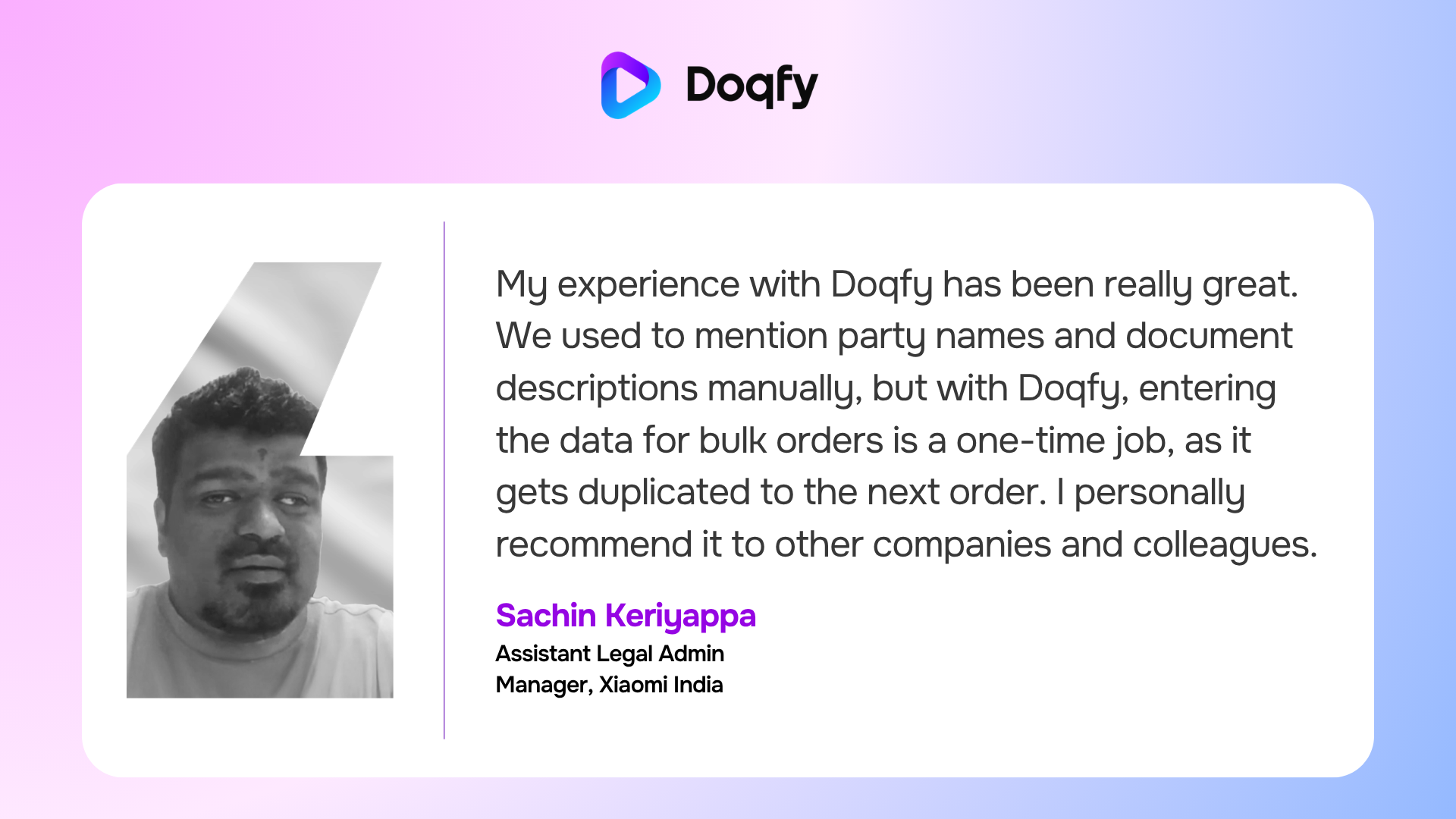
- Controlled content duplication across documents
- Approval workflows and automated routing
- Aadhaar eSign, DSC, and India-ready eStamping to support compliant execution
- Auth Gateway including eKYC and eKYB capabilities for validation and security
- Centralized repository, alerts, and renewal visibility for simplified management
With that foundation in place, bulk execution starts to feel less like chasing documents and more like running a repeatable system.
What good bulk CLM looks like in practice
1. One source of truth
- Every agreement should move through a common workflow.
- Teams should not be guessing which file is current or where it sits.
2. Less dependency on follow-ups
- Bulk processes break when progress depends on repeated reminders from operations or legal teams.
- Good CLM reduces that manual chasing.
3. Faster exception handling
- Not every agreement will stay standard.
- A strong system helps teams identify exceptions quickly without disrupting the entire batch.
4. Better audit readiness
- When hundreds of agreements are executed, retrieval cannot become a separate project.
- The right contract management software makes evidence, access, and tracking easier.
5. Visibility across the full cycle
- Bulk execution should not end at signature.
- Enterprises also need to know what happens after execution, especially for renewals, obligations, and compliance checkpoints.
Conclusion
Executing hundreds of agreements and contracts without chaos needs a system that scales with volume grows.
It brings structure to the parts of contract execution that usually break under pressure: drafting consistency, approval movement, signing coordination, tracking, and post-sign visibility.
For enterprises managing contracts at scale, the right contract management software does more than organize documents. It reduces friction without reducing control.
And it gives the business a clearer way to handle volume without creating operational confusion every time a batch needs to move.
If your organization is handling high agreement volumes and wants a more scalable way to execute, track, and manage them, the next step is to see what that workflow looks like in practice.
Book a demo with Doqfy and see how bulk contract execution can become faster, cleaner, and easier to manage at scale.