
Clause Standardization And Deviation Control Across Business Units
Clause standardization and deviation control across business units improves speed, consistency, and auditability by using playbooks and fallback positions, standardized templates, deviation scoring, and governed approvals to enforce redlines and post-sign controls with a defensible audit trail.
Clause Standardization And Deviation Control is one of the fastest ways to reduce contract risk while improving cycle time across enterprise teams. In many organizations, Sales, Procurement, Partnerships, and Operations each negotiate their own “preferred” language, which leads to inconsistent positions on liability, data protection, SLAs, payment terms, and termination rights. Over time, this inconsistency becomes expensive: approvals slow down, disputes become harder to resolve, and audits turn into reconstruction exercises.
A structured clause model helps every business unit move faster within clear boundaries, while keeping Legal and Compliance in control of exceptions.
Why Clause Standardization And Deviation Control Break Down Across Business Units
The root cause is rarely a lack of intent. It is usually a lack of shared operating rules, combined with contract volume and decentralized negotiation.
Below are the common failure patterns that create inconsistency:
- Templates Drift Through “Local Improvements”Each business unit modifies wording to suit immediate needs, and the template library silently fragments.
- Fallback Positions Are Tribal KnowledgeNegotiators know what worked last time, but that guidance is not documented or consistently applied.
- Deviation Reviews Are Triggered Too LateLegal sees high-risk redlines after commercial terms have been agreed, which forces rework and delays.
- Approvals Are Not Calibrated To MaterialityLow-impact edits get escalated, while high-impact deviations can slip through without the right review.
- Audit Trails Are IncompleteDecisions are made in email threads or calls without a recorded rationale, creating gaps during disputes or audits.
Clause Standardization And Deviation Control Starts With A Playbook, Not A Policy
A policy describes what should happen. A playbook makes it operational for the people negotiating contracts every day. The goal is to remove ambiguity by defining a standard position and a small number of approved alternatives.
To make the playbook usable across business units, structure it around contract types and clause categories:
- Define Standard Clauses Per Contract TypeFor example, NDAs, MSAs, vendor agreements, and channel partner contracts should each have their own clause baseline.
- Document Approved Fallback PositionsThis clarifies what can be accepted without escalation and what must be reviewed.
- Tag Clauses By Risk And OwnershipAssign primary owners (Legal, Security, Finance, Compliance) so deviations route to the right reviewers.
- Maintain A Change Log For Playbook UpdatesWhen a clause position changes, record when it changed, why, and where it applies.
Clause Standardization And Deviation Control Requires Clear Clause “Bands”
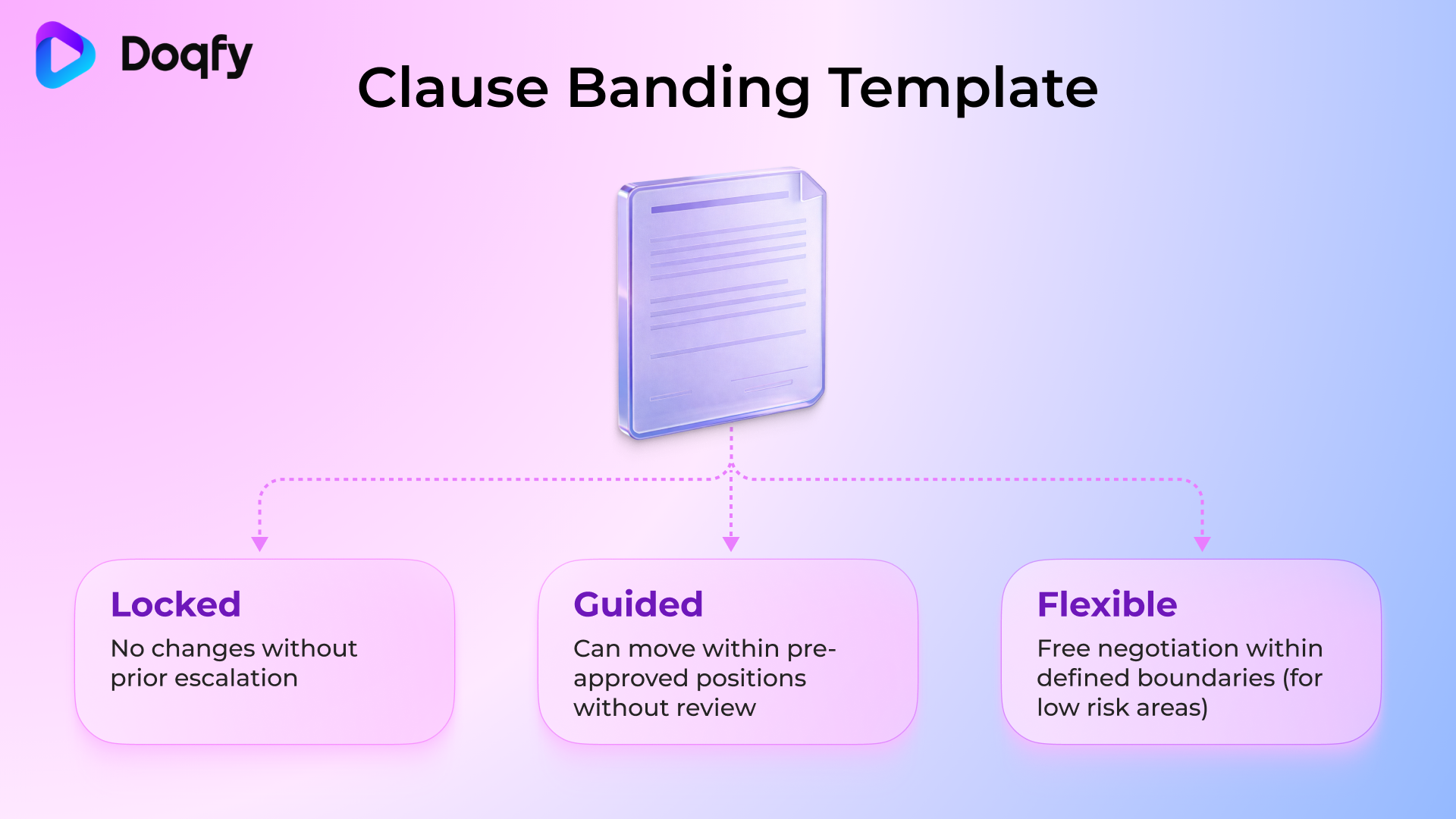
A practical way to scale adoption is to categorize every playbook clause into a small set of bands that business teams can follow consistently.
Use a banding model like this:
- Locked: The clause cannot be edited without escalation and approval.
- Guided: The clause can move within approved fallback positions without additional review.
- Flexible: The clause can be negotiated within defined boundaries, typically for low-risk areas.
Clause Standardization And Deviation Control Needs Deviation Scoring And Routing
Standardization alone does not solve the real-world problem: counterparties will negotiate. Deviation control is how you keep negotiation from becoming uncontrolled risk.
Before you introduce routing logic, set the expectation that deviations are normal, and only material deviations require escalation. Then apply a simple scoring and workflow approach:
Detect Deviations Against The Playbook Baseline
Compare redlines to standard text so the system can identify what changed and where.
Score Deviations By Clause Materiality
Materiality can be based on clause type and impact, such as liability caps, indemnities, data security obligations, audit rights, or termination terms.
Route Reviews Based On Deviation Type And Contract Context
Context signals include contract value, counterparty type, data access, geography, and business unit.
Require Rationale For Exceptions
A recorded reason is often the most useful artifact during audits and post-incident reviews.
Clause Standardization And Deviation Control In Approvals Without Adding Cycle Time
Most delays come from rework and unclear standards, not from governance itself. If business units know what is acceptable before negotiation begins, escalation volume drops and approvals become more predictable.
To keep cycle time under control, implement these practices:
Shift Reviews Earlier In The Workflow
Intake captures key signals so high-risk contracts are routed before negotiation is finalized.
Use Threshold-Based Approvals
Only escalate when deviation score, contract value, or vendor tier crosses a threshold.
Create A Fast Lane For Low-Risk Contracts
Standard templates with locked clauses can move through minimal review.
Set Response SLAs For Reviewers
Review time becomes a managed metric, not a recurring uncertainty.
Clause Standardization And Deviation Control After Signing
Deviation control cannot stop at execution. Post-sign, the organization still needs to operate against the correct terms and monitor commitments that were negotiated.
A complete approach includes:
A “Current Terms” View For Operations
Teams should be able to see key positions and negotiated exceptions without reading the full agreement.
Obligation Tracking For Negotiated Commitments
This includes notice periods, renewal windows, reporting requirements, and SLA measurement obligations.
A Controlled Amendment Workflow
If clauses change later, amendments should be linked to the base contract with a preserved version history.
Portfolio Reporting On Deviations
Track which clauses are frequently deviated, by business unit and counterparty type, to improve the playbook over time.
Conclusion
Summing up, Clause Standardization And Deviation Control gives enterprise teams a shared contracting language across business units, while keeping risk decisions consistent and auditable. A strong playbook establishes the baseline, deviation scoring ensures escalation is proportional, and approval routing aligns the right reviewers to the right changes. When these elements work together, contracting becomes easier to scale without creating avoidable exposure.