
AI in Contract Management Software: The 2026 Leap for Indian Businesses
In 2026, AI contract management helps Indian teams draft, review, approve, and track contracts faster and securely. Impact comes from clause extraction, playbook checks, smart routing, renewal tracking, version control, access management, and compliant e-sign execution.
Contract Management Software is Becoming an AI Priority
In 2026, contract management software is no longer a repository that sits politely in the corner of Legal Ops.
It is turning into an execution engine for sales, procurement, finance, and compliance, especially as contract volumes grow and cycle times get scrutinized.
AI is accelerating this shift because it reduces two persistent drains on productivity: The time it takes to read and interpret contracts, and the time it takes to coordinate reviews and approvals across teams.
When implemented with the right guardrails, AI helps teams move faster without turning governance into a game of “who edited this clause and why.”
Why Contract Management Software Needs an AI Upgrade in 2026
Contract management software is being judged on outcomes, not storage
Leaders now expect answers, not attachments: what risk sits in the portfolio, what obligations are due, and where deviations are happening at scale.
Contract management software must keep up with volume and velocity
Vendor onboarding, renewals, channel partnerships, and enterprise sales contracts are all running in parallel. Manual review models do not scale gracefully.
Contract management software is under stronger audit expectations
Auditability is becoming a feature for enterprises, not a phase.
Traceable edits, approvals, and execution records matter more in regulated and enterprise environments.
India’s IT Act recognizes electronic signatures and electronic records, which makes execution possible digitally, but it also raises the bar on how clean your evidence trail is.
Core AI Workflows Inside Contract Management Software
- Extracts key clauses (indemnity, limitation of liability, termination, payment terms)
- Flags risky language and missing boilerplate based on playbooks
- Creates structured “what changed” summaries for faster negotiation cycles
- AI can route contracts based on value, contract type, and deviation level
- It can generate role-specific summaries so stakeholders approve with context
- It can standardize deviation reporting so Legal reviews fewer “low-signal” escalations
- Converts signed documents into trackable obligations, milestones, and notice periods
- Reduces renewal leakage by monitoring dates, triggers, and owners
- Builds a searchable evidence trail for audits and internal reviews
- Enables meaning-based search across contracts, not just keyword search
- Surfaces concentration risk (for example, repeated non-standard clauses across vendors)
- Produces leadership-ready views of renewals, deviations, and pending obligations
Portfolio analytics in contract management software
Post-sign obligations in contract management software
Approvals and routing in contract management software
Pre-sign review and negotiation in contract management software
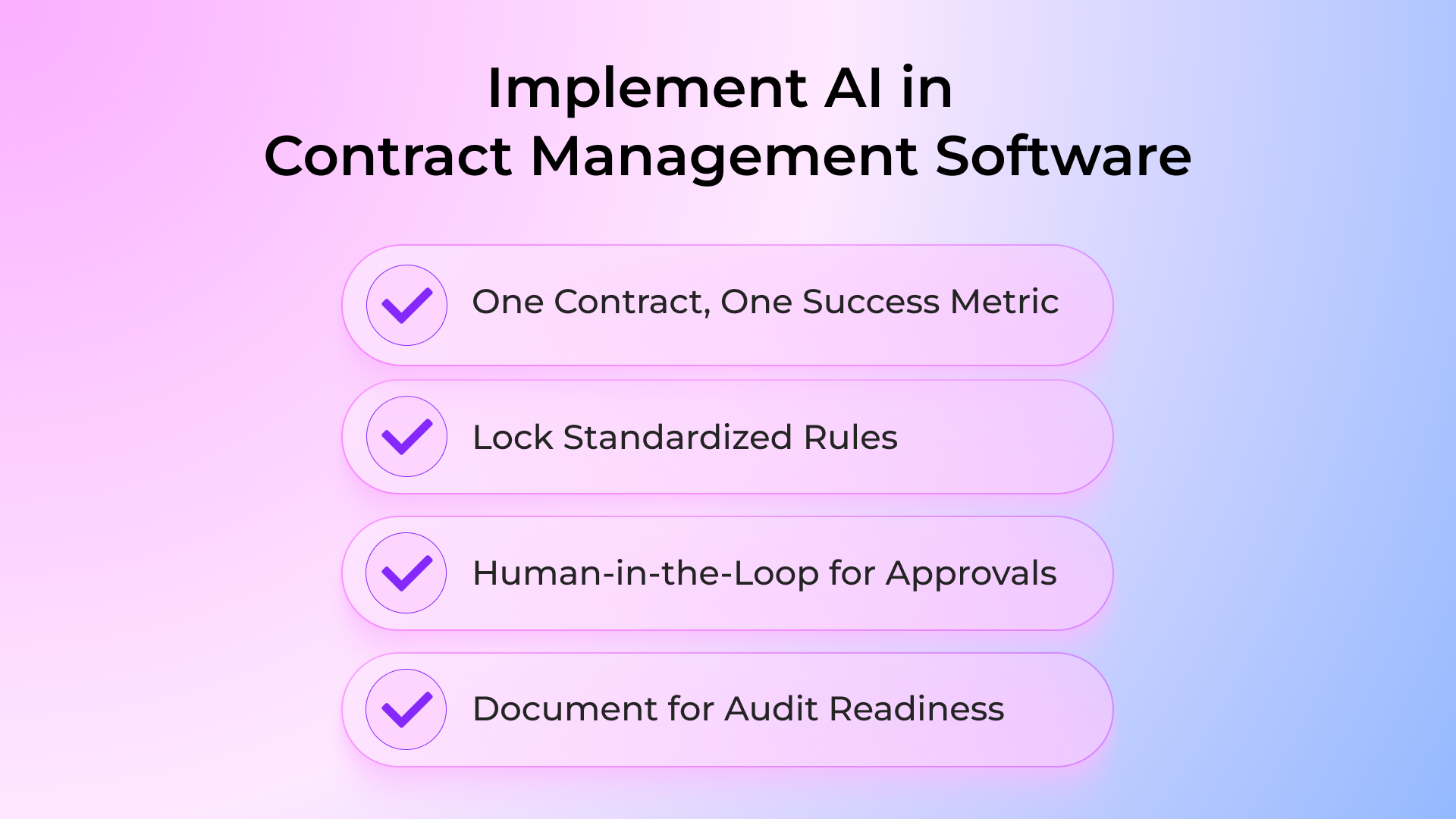
How to Implement AI in Contract Management Software Without Creating New Risk
- Pick a repeat-heavy workflow (NDAs, vendor agreements, MSAs, service contracts)
- Define success clearly: cycle time reduction, deviation reduction, renewal compliance
- Templates, clause libraries, fallback positions, and approval thresholds need to be explicit
- If the rules are vague, AI will faithfully accelerate the wrong process (a true talent)
- Use AI to suggest language and highlight risks
- Keep approvals, deviations, and final sign-off owned by accountable reviewers
- Version history for every change
- Time-stamped approvals with role and rationale
- Centralized repository with permissions and tamper-evident execution records
Instrument everything for audit and accountability
Use “AI proposes, humans approve” for sensitive decisions
Lock your “rules of the road” before you automate
Start narrow: one contract type, one success metric
India Guardrails for Contract Management Software in 2026
- Ensure your execution workflows preserve signer intent, authentication, and integrity of the final record
- Electronic signatures are legally recognized under India’s IT Act, which makes compliance-friendly digital execution feasible when implemented correctly.
- If you operate in regulated lending or high-compliance environments, operational transparency and traceability become non-negotiable
- RBI’s Digital Lending Directions (2025) reflect the continuing emphasis on governance and controls in digital credit ecosystems, reinforcing why audit-ready workflows matter.
- Role-based access control, redaction, and controlled exports help keep sensitive contract data from leaking into the wrong hands
- Keep AI outputs traceable to source text and versioned artifacts
Data governance inside contract management software
Regulated operations need stronger evidence trails
Execution and legal defensibility in contract management software
Conclusion
Summing up, the 2026 leap demonstrates that AI-powered contract workflows have very real benefits in terms of speed and productivity.
AI can make contract management software reliable under real operating conditions: High volume, multiple stakeholders, tight timelines, and audit scrutiny.
The practical path is to focus on a few high-impact workflows, keep approvals accountable, and ensure every AI-assisted action leaves a clean trail.
If your contracts are where revenue, cost, and risk meet, AI is not a novelty layer. It is the difference between “contracting as a bottleneck” and “contracting as a predictable system.”